
Cars
For decades, the “Kitna Deti Hai?” (What is the mileage?) question ruled the Indian car market. But as we move through 2026, a new question has taken over: “Kitni Safe Hai?” (How safe is it?).
With Indian highways getting faster and awareness growing, safety is no longer a luxury—it’s a survival requirement. The good news is that you don’t need a ₹30 lakh SUV to stay protected. Today, even budget-friendly cars under ₹10 lakh are coming with 5-star ratings, stable body structures, and advanced safety technology.
If you’re also comparing mileage-focused options, check out our guide on Most Fuel-Efficient Cars Under ₹10 Lakh in India (2026).
Which Are the Safest Cars Under ₹10 Lakh in India?
The safest budget cars in India right now are dominated by Tata Motors, Mahindra, and the significantly improved Maruti Suzuki Dzire. Top-rated models include the Tata Punch, Tata Altroz, Mahindra XUV 3XO, and the new Maruti Dzire, all of which have secured 5-star safety ratings in Bharat NCAP or Global NCAP crash tests.
Why Car Safety Matters More Than Ever in India
India has one of the world’s highest road accident rates, and modern expressways now allow much higher average speeds than before.

Airbags Alone Cannot Save You
Many buyers still assume that “6 airbags” automatically means a safe car. That’s not true.
If the car’s body shell collapses during a crash, airbags become far less effective. Real safety comes from:
- Strong structural integrity
- Stable passenger cabin
- Effective crumple zones
- Electronic stability systems
Indian Buyers Are Becoming More Safety-Aware
Crash-test videos now influence buying decisions more than touchscreen size or sunroofs.
Families are actively searching for:
- NCAP ratings
- Child protection scores
- Body shell stability
- Real crash performance
If you’re confused between hatchbacks and SUVs in this budget, read: Hatchback vs Compact SUV Under ₹10 Lakh
Understanding Global NCAP and Bharat NCAP Ratings
You’ll usually see two major crash-testing authorities in India today:
Global NCAP
Global NCAP brought public attention to Indian car safety by independently crash-testing popular models.
Bharat NCAP (B-NCAP)
Bharat NCAP is India’s official crash-testing program designed specifically for Indian road conditions and regulations.
Both organizations evaluate:
- Frontal crash protection
- Side impact protection
- Child occupant safety
- Electronic Stability Control (ESC)
- Structural stability
A 5-star rating means the car provides excellent occupant protection during serious crashes.
Best 5-Star Safety Cars Under ₹10 Lakh in 2026
1. Tata Punch (Facelift)
The Tata Punch continues to dominate the affordable safety segment.

Why Buyers Love It
- 5-star Bharat NCAP rating
- SUV-like stance with compact dimensions
- Excellent visibility for city driving
- Strong body structure
Safety Highlights
- 6 airbags
- ESC
- 360-degree camera
- ISOFIX mounts
- Reinforced cabin structure
The Punch is ideal for small families who want SUV practicality without compromising crash protection.
2. New Maruti Suzuki Dzire (2026)
This is one of the biggest surprises in the Indian market.
For years, Maruti was criticized for weak crash performance. But the new Dzire changes that perception completely.
Why It Matters
- First Maruti sedan with full 5-star safety performance
- Improved high-tensile steel structure
- Better occupant protection
Standard Safety Features
- 6 airbags
- ESC
- ABS with EBD
- Hill hold assist
The Dzire proves Maruti is finally taking structural safety seriously.
3. Tata Altroz
The Altroz remains India’s safest mainstream hatchback.
Why It Stands Out
- Stable highway behavior
- Strong ALFA platform
- Excellent crash-test consistency
Available Across Fuel Types
- Petrol
- Diesel
- iCNG
That means buyers don’t need to compromise safety for lower running costs.
If you’re balancing mileage and safety together, also read: Best Mileage Cars Under ₹10 Lakh in India
4. Mahindra XUV 3XO
Mahindra’s latest compact SUV combines aggressive styling with serious safety engineering.
Key Strengths
- Wide stance
- Stable handling
- Heavy-duty road presence
Safety Equipment
- 6 airbags
- All-wheel disc brakes
- ESC
- ADAS features in higher variants
The XUV 3XO feels more substantial than many rivals in the same segment.
5. Tata Nexon
The Nexon remains one of the most influential safe cars ever launched in India.
Why It Changed the Market
- India’s first widely popular 5-star SUV
- Forced competitors to improve safety standards
- Strong child occupant protection
Major Features
- ESC
- Traction control
- Hill hold
- Connected safety features
Even years after launch, the Nexon remains a benchmark for affordable crash safety.
5-Star Safety Comparison Table (2026)
| Car Model | Adult Safety | Child Safety | Key Strength |
|---|---|---|---|
| Tata Punch | ⭐⭐⭐⭐⭐ | ⭐⭐⭐⭐⭐ | Compact SUV safety |
| Tata Altroz | ⭐⭐⭐⭐⭐ | ⭐⭐⭐⭐⭐ | Safest hatchback |
| Tata Nexon | ⭐⭐⭐⭐⭐ | ⭐⭐⭐⭐⭐ | Family SUV protection |
| Maruti Dzire | ⭐⭐⭐⭐⭐ | ⭐⭐⭐⭐ | Safer Maruti structure |
| Mahindra XUV 3XO | ⭐⭐⭐⭐⭐ | ⭐⭐⭐⭐ | SUV stability |

Don’t Confuse Features With Actual Safety
Indian buyers often get distracted by flashy showroom features.
But here’s the reality:
These Are NOT Safety Features
- Sunroof
- Ambient lighting
- Large touchscreen
- Wireless charger
These ACTUALLY Matter
- ESC
- Strong body shell
- ISOFIX mounts
- Side impact protection
- Crumple zones
A cheaper car with strong crash protection is safer than an expensive car loaded with gadgets but poor structural integrity.
Why Tata Motors Became India’s Safety Leader
Tata completely changed how Indians think about safety.
Before the Nexon’s breakthrough crash-test performance, most buyers focused mainly on:
- Mileage
- Resale value
- Features
Today, “Tata Safety” itself has become a selling point.
Models like:
- Punch
- Altroz
- Nexon
regularly dominate discussions around budget safety in India.
If you’re comparing overall value-focused cars, explore: Best Cars Under ₹10 Lakh in India (2026)
Are Safer Cars More Expensive to Maintain?
Not necessarily.
A safer car may:
- Weigh slightly more
- Deliver marginally lower mileage
- Cost slightly more to repair after a crash
But the long-term tradeoff is worth it.
Why Safety Saves Money Long-Term
- Better occupant protection
- Lower injury risk
- Improved highway confidence
- Better resale perception over time
The cost difference in fuel is tiny compared to the financial and emotional cost of a major accident.
Common Questions Buyers Ask About Safe Cars
Which is the safest car under ₹10 lakh in India?
The Tata Punch and Tata Altroz currently offer some of the strongest adult and child protection scores in this price range.
Is Tata safer than Maruti?
Historically yes, but the new-generation Maruti Dzire shows that Maruti is finally improving structural safety significantly.
What does a 5-star NCAP rating mean?
It means the vehicle performed exceptionally well in crash tests involving frontal and side impacts while protecting adult and child occupants.
Are airbags enough for safety?
No. Airbags only work properly when combined with a strong body shell and stable structure.
Which is the safest hatchback in India?
The Tata Altroz remains India’s best-known 5-star safety-rated premium hatchback.
What safety features should buyers prioritize?
Focus on:
- ESC
- Strong crash-test scores
- ISOFIX mounts
- Side impact protection
- Structural stability

Final Verdict: Safety Should Be Your First Filter
In 2026, Indian buyers finally have genuine 5-star safety options under ₹10 lakh.
That’s a massive shift from just a few years ago.
Whether you choose the Tata Punch, Altroz, Nexon, XUV 3XO, or the new Dzire, prioritize:
- Crash protection
- Structural integrity
- Family safety
before flashy features or oversized touchscreens.
A car’s real job is not just getting you somewhere quickly — it’s bringing your family home safely every single day.
Quick Takeaways for Buyers
- Tata Motors still leads affordable crash safety in India
- The new Maruti Dzire is a major improvement in safety
- Structural strength matters more than gadgets
- 5-star crash ratings are now available even below ₹10 lakh
- Always compare adult and child protection separately
Helpful Resources for Indian Car Buyers
Official Safety Rating Websites
- Bharat NCAP Official Website — India’s official crash-testing and vehicle safety rating platform. Includes adult and child occupant scores, crash-test protocols, and tested vehicle lists.
- Global NCAP – Safer Cars for India — Global crash-test program that pushed Indian manufacturers toward safer vehicle structures and occupant protection standards.
- Reserve Bank of India (RBI) — Official source for repo rates, lending rules, and banking regulations in India. (rbi.org.in)
- TransUnion CIBIL — Check your credit score and track your loan eligibility before applying for a car loan.
- SBI Car Loans — View latest interest rates, eligibility criteria, and loan offers from State Bank of India.
- HDFC Bank Car Loans — Explore car loan options, EMIs, and financing plans from HDFC Bank.
- ICICI Bank Car Loans — Compare new and used car loan offers along with repayment options.
- Policybazaar Car Insurance — Compare insurance plans, premiums, and add-on coverage options in one place.
- Acko Car Insurance — Get quick online quotes and renewal estimates for car insurance.
- AutomotiveZone Mileage Cost Calculator — Estimate real fuel costs based on your driving mileage.
- AutomotiveZone Monthly Car Expense Calculator — Calculate total monthly car ownership cost including EMI, fuel, and maintenance.
Disclaimer: Prices, mileage, safety ratings, loan rates, and ownership costs are approximate and may vary by location, variant, and market conditions in 2026. Some visuals may be AI-generated for illustration. Please verify final details with authorized dealers before purchase.
What You Should Know First
In 2026, the most fuel-efficient cars under ₹10 lakh in India are dominated by Maruti Suzuki’s Z-Series petrol engines and Tata’s iCNG range. Top petrol picks like the Maruti Swift offer a real-world mileage of 18–22 km/l, while CNG models like the WagonR and Tiago iCNG provide a running cost of roughly ₹2.5–₹3.5 per km, significantly lower than petrol alternatives.
Most Fuel-Efficient Cars Under ₹10 Lakh in India (2026 Edition)
If you are buying a car in India in 2026, you already know the drill: Petrol prices are high, traffic is getting worse, and that “claimed mileage” sticker on the showroom window feels more like a fairy tale than a promise.
Most Indian buyers today don’t just want a car; they want a “money-saver.” With ₹10 lakh as the sweet-spot budget, the goal is to find a vehicle that won’t make your wallet cry every time you visit the fuel station. Let’s look at the cars that actually deliver real-world efficiency in 2026.
1. Why Fuel Efficiency Matters More Than Ever in 2026
With petrol prices consistently hovering at high levels across Indian metros, the “running cost” has surpassed the “on-road price” as the most important factor for middle-class buyers.
A car that gives 12 km/l vs. one that gives 18 km/l can mean a difference of nearly ₹3,000–₹4,500 in your monthly budget if you drive 1,000 km. In 2026, fuel efficiency isn’t just a spec—it’s a monthly salary hike you give yourself.
2. Real Mileage vs. ARAI Mileage (The Big Reality Gap)
Before we look at the list, let’s address the elephant in the room: ARAI figures are recorded in labs, not on Indian roads.

- ARAI Testing: Conducted at steady speeds, no AC, and zero traffic.
- Indian Reality: Bumper-to-bumper traffic, 40°C heat with AC on full blast, and frequent gear shifts.
- The Catch: Expect your real-world mileage to be 20% to 30% lower than the brochure claim.
Related: Why ARAI mileage vs real mileage is different in India
3. Most Fuel-Efficient Petrol Cars Under ₹10 Lakh
If you want the flexibility of petrol without the massive bills, these three models lead the pack in 2026:
- Maruti Suzuki Swift (Z-Series): The 3-cylinder Z-Series engine is a masterpiece of efficiency. In real-world city conditions, it easily delivers 18–20 km/l, stretching to 24 km/l on highways.
- Maruti Baleno / Toyota Glanza: These premium hatchbacks use idle start-stop technology effectively to deliver a solid 17–19 km/l in city traffic.
- Tata Punch (Petrol): While slightly heavier, the refined Revotron engine in the 2026 Facelift version manages 14–16 km/l in the city, offering a balance of SUV looks and decent thrift.
4. Best CNG Cars for Maximum Savings
For those driving more than 40 km a day, CNG is the undisputed king of savings under ₹10 lakh.

- Maruti WagonR CNG: The “Mileage Legend.” It remains the cheapest way to travel in India, offering a real-world 26–28 km/kg.
- Tata Tiago iCNG: With Tata’s “Twin Cylinder” technology, you get the savings of CNG without losing your entire boot space. It delivers a real-world 22–24 km/kg.
- Maruti Dzire CNG: The 2026 model, now with a 5-star safety rating, offers a premium feel with a running cost of roughly ₹3 per km.
5. Petrol vs. CNG vs. Hybrid: What Actually Saves Money?
In the sub-₹10 lakh segment, “Strong Hybrids” are rare, so the choice is usually between refined Petrol and cost-effective CNG.
| Fuel Type | Avg. Real Mileage | Running Cost (per km) | Best For |
| Petrol | 15–18 km/l | ₹6.5 – ₹7.5 | Low usage, highway trips |
| CNG | 22–26 km/kg | ₹3.0 – ₹4.0 | High daily commute, city use |
| Hybrid (Entry) | 19–21 km/l | ₹5.5 – ₹6.0 | Mixed usage, smoothness |
Explore more: Diesel vs petrol cars India 2026: Which to choose?
6. Real Monthly Fuel Cost Example (India)
Let’s look at the math for a 1,000 km monthly commute in 2026:

- Standard Petrol Car (14 km/l): You spend ~₹7,500/month.
- Efficient Petrol (Swift – 19 km/l): You spend ~₹5,500/month.
- CNG Car (25 km/kg): You spend ~₹3,500/month.
- Annual Savings (Petrol vs. CNG): You save ₹48,000 per year. That’s basically two months of EMI for free!
7. Hidden Factors That Affect Your Mileage

It’s not just the car; it’s how you treat it. In 2026, modern sensors make these factors even more critical:
- Tire Pressure: Low pressure can drop mileage by 5%.
- AC Usage: Keeping the AC on “Auto” at 24°C is more efficient than “Full Cold.”
- Driving Style: Aggressive “floor-to-floor” driving in traffic is the #1 mileage killer.
Recommended: 7 Proven tips to increase your car’s fuel efficiency
8. Should You Trust Mileage Figures?
The Expert Advice: Never buy a car based on the salesperson’s word. Always check real-user reviews on forums or YouTube for “City Mileage” specifically. In 2026, the gap between the most and least efficient car in the ₹10 lakh segment can be as wide as ₹50,000 in annual fuel costs. Choose wisely.
Frequently Asked Questions (FAQ)
Which car gives the highest mileage under ₹10 lakh?
The Maruti Suzuki WagonR CNG and Celerio CNG currently offer the highest mileage, often exceeding 30 km/kg in ARAI tests and 26 km/kg in the real world.
Is CNG better than petrol in India?
If your daily running is more than 40-50 km, CNG is significantly better for your wallet. For occasional or low usage, petrol is better due to lower maintenance and better performance.
What is real mileage vs ARAI mileage?
ARAI mileage is tested in a lab. Real mileage is what you get in actual traffic. Usually, real mileage is 25% lower than the ARAI claim.
Which fuel type is cheapest per km?
Currently, CNG is the cheapest per km for internal combustion engines, followed by EVs (if you have home charging).
Can driving style improve mileage?
Yes. Smooth acceleration, keeping the engine between 1,500–2,500 RPM, and avoiding sudden braking can improve efficiency by up to 15%.
Final Verdict
In 2026, a fuel-efficient car isn’t a luxury; it’s a necessity. If you want the absolute lowest bills, go for Maruti’s CNG range. If you want a fun-to-drive car that is still kind to your pocket, the new Swift or Baleno are your best bets. Happy (and thrifty) driving!
Don’t just look at the shiny touchscreen in the showroom. Ask to see the “Instantaneous Fuel Economy” on a test drive in heavy traffic—that’s the number that will define your relationship with the car for the next five years.
Helpful Resources
- Reserve Bank of India (RBI) — Official source for repo rates, lending rules, and banking regulations in India. (rbi.org.in)
- TransUnion CIBIL — Check your credit score and track your loan eligibility before applying for a car loan.
- SBI Car Loans — View latest interest rates, eligibility criteria, and loan offers from State Bank of India.
- HDFC Bank Car Loans — Explore car loan options, EMIs, and financing plans from HDFC Bank.
- ICICI Bank Car Loans — Compare new and used car loan offers along with repayment options.
- Policybazaar Car Insurance — Compare insurance plans, premiums, and add-on coverage options in one place.
- Acko Car Insurance — Get quick online quotes and renewal estimates for car insurance.
- AutomotiveZone Mileage Cost Calculator — Estimate real fuel costs based on your driving mileage.
- AutomotiveZone Monthly Car Expense Calculator — Calculate total monthly car ownership cost including EMI, fuel, and maintenance.
Disclaimer: Prices, mileage, safety ratings, loan rates, and ownership costs are approximate and may vary by location, variant, and market conditions in 2026. Some visuals may be AI-generated for illustration. Please verify final details with authorized dealers before purchase.
Under ₹10 lakh in India, hatchbacks generally offer better value for money due to higher mileage, lower maintenance, and easier city driving. However, compact SUVs justify their higher cost with better ground clearance, road presence, and comfort on bad roads. Your choice depends on whether you prioritize savings or practicality.
If your priority is fuel efficiency, lower maintenance, and stress-free city driving, a premium hatchback makes more sense under ₹10 lakh. But if you regularly drive on broken roads, want higher ground clearance, and prefer a more commanding driving position, a compact SUV is usually the better long-term choice for Indian conditions.
Hatchback vs Compact SUV Under ₹10 Lakh: Which Should You Buy in 2026?
If you walked into a car showroom in India today with a ₹10 lakh budget, you’d likely find yourself standing between a premium hatchback and a compact SUV. It’s one of the biggest car-buying dilemmas in 2026.
Compact SUVs look tougher, sit higher, and feel more premium on Indian roads. But hatchbacks continue to deliver better mileage, easier city usability, and lower ownership costs. The right choice depends less on trends and more on your daily driving reality.
For some buyers, a hatchback saves money every single month. For others, a compact SUV solves everyday road problems that hatchbacks struggle with.
Let’s compare both properly before you spend your money.
Why Compact SUVs Became So Popular in India
Compact SUVs exploded in popularity because they solve many practical Indian-road problems while also giving buyers a stronger “big car” feeling.
Cars like the Tata Punch, Hyundai Exter, and Nissan Magnite have changed buyer preferences dramatically.
Why Compact SUVs Feel More Premium (But Cost More)
Compact SUVs like Nexon or Punch offer:
- Higher driving position and road visibility
- Better suspension for potholes and rough roads
- Stronger road presence
However, they usually come with:
- Lower mileage compared to hatchbacks
- Higher tyre and service costs
- Slightly higher insurance premiums
📌 Understand fuel efficiency differences:
👉 Increase Car Fuel Efficiency Tips India
For many Indian families, SUVs now feel like an “upgrade” from hatchbacks even when cabin space differences are small.
Why Hatchbacks Are Still the Best Value Under ₹10 Lakh
Hatchbacks like the Baleno or i20 remain strong value picks because they are:
- More fuel-efficient in city traffic
- Cheaper to maintain and insure
- Easier to park in tight urban spaces
📌 Read more about ownership costs:
👉 Cost of Car Ownership in India Beyond EMI
Where hatchbacks save money
- Better fuel efficiency
- Lower tire replacement cost
- Lower insurance premiums
- Easier parking in crowded cities
- Lower servicing expenses
- Better maneuverability in traffic
If your driving is mostly inside cities like Delhi, Mumbai, Pune, or Bengaluru, hatchbacks often feel easier to live with daily.
You can also explore the full breakdown of true monthly car ownership costs beyond EMI before choosing between segments.
Space and Comfort Comparison
Many buyers assume compact SUVs automatically offer much more cabin space. In reality, that’s not always true.
Premium hatchbacks like the Baleno and i20 often provide surprisingly good rear-seat comfort and cabin width.

Compact SUVs are better for:
- Higher seating comfort
- Easier entry for older passengers
- Better visibility
- Slightly larger boot space
- Rough-road confidence
Hatchbacks are better for:
- Easier parking
- Lower loading height
- Better city maneuverability
- More stable handling feel in some cases
If your family frequently travels with luggage or elderly passengers, compact SUVs usually feel more comfortable overall.
Mileage and Running Cost Comparison
Mileage remains one of the biggest deciding factors under ₹10 lakh because fuel prices in India continue to stay high.
| Factor | Premium Hatchback | Compact SUV |
|---|---|---|
| City Mileage | Higher | Moderate |
| Highway Mileage | Very Good | Good |
| Tire Cost | Lower | Higher |
| Fuel Efficiency | Better | Slightly lower |
| Maintenance Cost | Lower | Moderate |
| Parking Ease | Easier | Harder |

Why hatchbacks give better mileage
Hatchbacks are:
- lighter
- more aerodynamic
- easier to accelerate
- less demanding on tires and brakes
This directly reduces fuel consumption.
If you’re comparing real-world efficiency, check this detailed guide on ARAI mileage vs real-world mileage differences.
Real-World Mileage Impact: The Hidden Cost Gap
In real Indian driving conditions:
- Hatchbacks → Better real mileage efficiency
- Compact SUVs → 10–25% higher fuel consumption
📌 Learn why real mileage differs from claims:
👉 ARAI Mileage vs Real Mileage India
Which Is Better for Indian City Driving?

For dense urban traffic, hatchbacks still dominate practicality.
Why hatchbacks work better in cities
- Smaller turning radius
- Easier parallel parking
- Better traffic maneuverability
- Lower clutch fatigue
- Better fuel efficiency in stop-go traffic
In crowded areas where parking space is limited, hatchbacks simply reduce daily driving stress.
However, compact SUVs feel more comfortable over bad roads, flooded streets, and broken speed breakers commonly found in Indian cities.
Safety Comparison: Hatchback vs Compact SUV
Many buyers believe SUVs are automatically safer because they look larger. That assumption is misleading.
Crash-test ratings matter far more than body style.
Important reality check
A 5-star hatchback can easily be safer than a poorly rated SUV.
Strong safety options under ₹10 lakh
- Tata Altroz
- Tata Punch
- Hyundai Exter
- New Maruti Dzire
Modern hatchbacks now offer:
- 6 airbags
- ESC
- hill-hold assist
- rear cameras
- stronger crash structures
Always prioritize safety ratings instead of just size.
Highway Comfort and Long-Distance Driving
Compact SUVs genuinely feel more relaxed on long-distance drives.
SUVs perform better for:
- bad highways
- village roads
- luggage carrying
- rough-road suspension comfort
- higher seating confidence
Hatchbacks perform better for:
- stable handling
- smoother high-speed cornering
- quieter city refinement
- lower fuel spending
If your driving regularly includes highway trips with family luggage, compact SUVs usually feel more versatile.
Maintenance and Ownership Costs Over 5 Years
The purchase price is only one part of ownership. Running costs matter far more long term.
Compact SUVs usually cost more because of:
- larger tires
- higher fuel consumption
- higher insurance premiums
- slightly more expensive servicing
Hatchbacks remain cheaper because of:
- lighter components
- better mileage
- lower spare-part cost
- smaller tire sizes
Before buying, it’s smart to compare the hidden expenses of owning a car in India.
Real Ownership Example: Baleno vs Punch
Let’s compare practical running costs for a buyer driving 1,000 km monthly.
Long-Term Ownership Cost Difference (Important Insight)
Over 5 years:
- Hatchbacks save money on fuel + maintenance
- SUVs may cost more but offer lifestyle comfort
📌 Full financial breakdown:
👉 True Cost of Car Ownership Hidden Expenses India
Maruti Baleno
- Average mileage: 20 kmpl
- Monthly fuel use: ~50L
- Estimated monthly fuel cost: ~₹5,250
Tata Punch
- Average mileage: 15 kmpl
- Monthly fuel use: ~66L
- Estimated monthly fuel cost: ~₹6,930
The long-term difference
The SUV may cost nearly ₹20,000 more annually in fuel alone.
Over 5 years, that gap can exceed ₹1 lakh.
That’s why segment choice impacts long-term ownership cost significantly.
Who Should Buy a Hatchback?
A hatchback makes more sense if you are:
- a first-time buyer
- a city commuter
- looking for maximum mileage
- focused on low maintenance
- driving mostly in urban traffic
- prioritizing easier parking
Premium hatchbacks remain the smartest choice for practical urban ownership.
Who Should Buy a Compact SUV?
A compact SUV is better if you:
- frequently drive on bad roads
- travel with family regularly
- want better ground clearance
- need easier ingress for elderly passengers
- prefer stronger road presence
- do frequent highway trips
For mixed city + highway usage, compact SUVs often feel more versatile overall.
Common Mistakes Buyers Make
Buying SUVs only for “status”
Many buyers overspend on SUVs despite mostly city usage.
Ignoring fuel cost differences
Even a 3–4 kmpl mileage difference becomes expensive long term.
Stretching the EMI budget
Higher EMIs increase overall financial stress.
You should also compare how your CIBIL score affects car loan approval and interest rates before increasing your budget unnecessarily.
Ignoring real driving conditions
Road quality, parking space, family size, and daily running matter more than social trends.
Financing Reality: EMI Doesn’t Tell the Full Story
Even if EMI is similar, loan eligibility and interest rate affect total cost:
- Strong credit score → lower EMI burden
- Weak score → higher total loan cost
📌 Check impact on loans:
👉 How CIBIL Score Affects Auto Loan Approval India

Frequently Asked Questions
Which is better under ₹10 lakh: hatchback or compact SUV?
Hatchbacks are better for city driving and mileage, while compact SUVs are better for rough roads and family travel.
Are compact SUVs safer than hatchbacks?
Not always. Safety depends on crash-test ratings and build quality, not just vehicle size.
Which gives better mileage: SUV or hatchback?
Hatchbacks generally deliver better mileage because they are lighter and more aerodynamic.
Which has lower maintenance costs?
Hatchbacks usually cost less to maintain because of cheaper tires, better fuel efficiency, and lower insurance premiums.
Which is better for Indian roads?
Compact SUVs handle potholes and rough roads more comfortably due to higher ground clearance.
Should first-time buyers choose hatchbacks or SUVs?
For most first-time buyers, hatchbacks remain easier to drive, cheaper to maintain, and more practical in cities.
What Most Buyers Should Prioritize
There is no universal winner between hatchbacks and compact SUVs.
Choose a hatchback if:
- your driving is mostly urban
- mileage matters most
- parking is difficult
- you want lower monthly expenses
Choose a compact SUV if:
- roads around you are poor
- family comfort matters more
- you travel frequently
- you prefer a higher driving position
The smartest choice is not the trendiest vehicle, it’s the one that fits your daily driving reality, fuel budget, and long-term ownership comfort.
Helpful Resources
- Reserve Bank of India (RBI) — Official source for repo rates, lending rules, and banking regulations in India. (rbi.org.in)
- TransUnion CIBIL — Check your credit score and track your loan eligibility before applying for a car loan.
- SBI Car Loans — View latest interest rates, eligibility criteria, and loan offers from State Bank of India.
- HDFC Bank Car Loans — Explore car loan options, EMIs, and financing plans from HDFC Bank.
- ICICI Bank Car Loans — Compare new and used car loan offers along with repayment options.
- Policybazaar Car Insurance — Compare insurance plans, premiums, and add-on coverage options in one place.
- Acko Car Insurance — Get quick online quotes and renewal estimates for car insurance.
- AutomotiveZone Mileage Cost Calculator — Estimate real fuel costs based on your driving mileage.
- AutomotiveZone Monthly Car Expense Calculator — Calculate total monthly car ownership cost including EMI, fuel, and maintenance.
Disclaimer: Prices, mileage, safety ratings, loan rates, and ownership costs are approximate and may vary by location, variant, and market conditions in 2026. Some visuals may be AI-generated for illustration. Please verify final details with authorized dealers before purchase.
Best Cars Under ₹10 Lakh in India (2026) – Quick Overview
Cars under ₹10 lakh in India offer a versatile mix of premium hatchbacks, micro-SUVs, and high-efficiency CNG models. In 2026, top choices include the Tata Punch (Facelift) for safety, Maruti Suzuki Baleno for mileage and tech, and the Hyundai i20 for premium features. Your choice should depend on whether you prioritize city commuting, family safety, or low running costs.
Most Indian car buyers don’t struggle with options, they struggle with choosing the right car under ₹10 lakh without regret later.
In 2026, this segment has become highly competitive. You’re no longer choosing between “basic cars” you’re choosing between safe SUVs, premium hatchbacks, and fuel-efficient CNG options.
The real question is simple:
👉 Which car actually fits your daily life, not just your budget?
💡 Why ₹10 Lakh Is the Most Important Car Budget in India
₹10 lakh is the sweet spot for most Indian buyers.
At this price point, you typically get:
- Top-end hatchbacks or entry SUVs
- 6 airbags in many models
- Touchscreen infotainment systems
- Reverse camera and connected features
- Multiple fuel options (Petrol, CNG)
Most importantly, EMI stays around ₹15,000–₹18,000/month, which fits middle-class budgets comfortably.
Before applying for financing, it’s important to know the minimum CIBIL score for car loan approval because your credit profile directly impacts interest rates and EMI affordability.
🚘 Best Hatchbacks Under ₹10 Lakh (2026)

Ideal for city driving, daily office use, and low running costs.
🚗 Maruti Suzuki Baleno
- Mileage: ~22–23 km/l (Petrol), 30+ km/kg (CNG)
- Strength: Low maintenance + strong resale value
- Best for: Daily commuters and budget-focused buyers
🛡️ Tata Altroz
- 5-star safety rating
- Strong build quality for highways
- Slightly lower mileage but excellent stability
✨ Hyundai i20
- Premium interior feel
- Best-in-class features and infotainment
- Ideal for comfort-focused buyers
🚙 Best Compact SUVs Under ₹10 Lakh

SUVs are popular in India due to road conditions, monsoon driving, and higher seating position.
🚗 Tata Punch (2026 Facelift)
- 5-star safety
- High ground clearance
- Best all-round city SUV
🚗 Hyundai Exter
- 6 airbags standard
- Sunroof + dashcam features
- Feature-rich compact SUV
🚗 Nissan Magnite
- Turbo engine under ₹10 lakh
- Strong highway performance
- Best value-for-money SUV
⛽ Best CNG Cars Under ₹10 Lakh

CNG is the most cost-efficient fuel option for high daily usage.
🚗 Maruti WagonR CNG
- Extremely low running cost
- Simple and reliable
- Best for budget families
🚗 Tata Tiago iCNG
- Twin-cylinder tech (usable boot space)
- Safe and practical for city use
🚗 Maruti Dzire CNG
- Sedan comfort with CNG savings
- Strong resale value
- Improved safety in newer models
Your fuel choice can dramatically affect long-term running expenses, maintenance bills, and resale value. This detailed guide on diesel vs petrol ownership cost in India explains which option makes more financial sense in 2026.
⚖️ Mileage vs Safety vs Features: What Should You Choose?

You usually have to prioritise two out of three.
| Priority | Best Cars | Why |
|---|---|---|
| 🛡️ Safety | Tata Punch, Altroz | Strong build + NCAP ratings |
| ⛽ Mileage | Maruti Baleno, Swift | Lowest running cost |
| 🎛️ Features | Hyundai i20, Exter | Best tech and comfort |
Many buyers are surprised when their real-world fuel economy is far lower than official claims. Understanding the difference between ARAI mileage vs real mileage helps set realistic expectations before buying a new car.
💰 Real Monthly Cost of a ₹10 Lakh Car

Most buyers focus only on EMI, but real cost is higher.
| Expense | Monthly Cost |
|---|---|
| EMI | ₹15,000 – ₹17,500 |
| Fuel | ₹6,000 – ₹8,500 |
| Insurance | ₹1,500 – ₹2,500 |
| Maintenance | ₹1,000 – ₹1,500 |
| Total Cost | ₹23,500 – ₹30,000 |
Most buyers only calculate the EMI while ignoring fuel, insurance, depreciation, and servicing expenses. Before finalizing your purchase, understand the true cost of owning a car beyond EMI to avoid financial surprises later.
👉 Real insight:
Your actual cost is around 1.5 to 1.8 times your EMI
⚠️ Common Mistakes Buyers Make
- Buying SUV for status instead of need
- Ignoring real fuel and maintenance costs
- Stretching loan tenure unnecessarily
- Choosing top variant without safety comparison
- Not checking service network availability
🧠 How to Choose the Right Car

Use this simple logic:
- 🚗 City driving (<30 km/day) → Petrol hatchback
- ⛽ High usage (>50 km/day) → CNG preferred
- 🛣️ Bad roads → SUV (Punch / Exter)
- 💰 Tight budget → Maruti / Tata base variants
- 🔁 Short ownership (3–5 years) → Strong resale brands
Common Questions About Cars Under ₹10 Lakh
Which is the best car under ₹10 lakh in India (2026)?
Tata Punch is currently the best overall choice for safety, comfort, and usability.
Which car gives the highest mileage under ₹10 lakh?
Maruti Baleno and Swift (especially CNG variants) offer the best mileage.
Is SUV better than hatchback under ₹10 lakh?
SUVs are better for bad roads, while hatchbacks offer better mileage and lower running costs.
Which is the safest car under ₹10 lakh?
Tata Punch and Tata Altroz are among the safest options in this segment.
Petrol or CNG, which is better?
CNG is better for high daily running; petrol is better for performance and flexibility.
🏁 Final Verdict: Which Car Should You Actually Buy?

A ₹10 lakh budget in 2026 gives you strong options across segments.
- Choose Tata if safety is your top priority
- Choose Maruti if mileage and resale matter most
- Choose Hyundai if comfort and features matter most
The best car is not the most expensive one, it’s the one that fits your daily driving life, fuel usage, and long-term budget.
Helpful Resources
- Reserve Bank of India (RBI) — Official RBI website for repo rates, banking rules, and auto loan regulations. (rbi.org.in)
- TransUnion CIBIL — Check and monitor your CIBIL score before applying for a car loan.
- SBI Car Loans — Compare current SBI car loan interest rates and eligibility.
- HDFC Bank Car Loans — Explore private bank car loan offers and EMI options.
- ICICI Bank Car Loans — Check financing options for new and used cars.
- Policybazaar Car Insurance — Compare insurance premiums and add-on covers.
- Acko Car Insurance — Useful for checking online insurance renewal costs.
- AutomotiveZone Mileage Cost Calculator — Estimate monthly fuel spending based on real mileage.
- AutomotiveZone Monthly Car Expense Calculator — Calculate true monthly ownership costs beyond EMI.
Disclaimer: Prices, mileage figures, safety ratings, loan interest rates, and ownership costs mentioned in this article are approximate estimates based on 2026 market trends and may vary by city, variant, dealership, driving conditions, and government regulations. Some visuals used in this article may be AI-generated for illustrative purposes only. Always verify the latest on-road prices, specifications, and finance offers with authorized dealers before making a purchase decision.
Mileage Claims vs Reality
ARAI mileage numbers are rarely achievable because they are recorded in controlled laboratory conditions with no traffic, no wind resistance, and most importantly, the Air Conditioning (AC) turned off. In real-world Indian driving—marked by stop-and-go traffic and high temperatures—actual mileage is typically 20% to 40% lower than the certified figure.
Why ARAI Certified Mileage Numbers Are Rarely Achievable in Real Life
Fuel prices in India are painful enough. What frustrates buyers even more is realizing their “22 km/l mileage car” barely returns 14–15 km/l in daily driving. The problem usually isn’t the car—it’s the massive difference between laboratory-tested ARAI mileage and real Indian road conditions filled with traffic, heat, bad roads, and AC usage.
If you feel misled, you aren’t alone. Thousands of Indian car buyers feel “cheated” by these numbers every year. But the truth isn’t that the manufacturers are lying; it’s that the ARAI mileage vs real mileage gap is a byproduct of how we test cars in India versus how we actually drive them.
1. What is ARAI Mileage Testing?
ARAI (Automotive Research Association of India) is the government-affiliated body that certifies every vehicle sold in India. To keep things fair, they test every car using the same standardized method called the Modified Indian Driving Cycle (MIDC).
How it’s measured:
Instead of driving on the Mumbai-Pune Expressway, the car is placed on a chassis dynamometer—essentially a massive treadmill for cars—inside a laboratory. The car “drives” a predetermined sequence of speeds and stops to calculate fuel consumption based on exhaust emissions.
2. Why ARAI Mileage Looks Higher Than Real Driving
The laboratory is a perfect world. Real life is… not. Here is why the lab numbers are so inflated:
- No Air Conditioning: In ARAI tests, the AC is switched off. In a country like India where summers hit 45°C, the AC can sap 10% to 20% of your fuel efficiency.
- Zero Wind Resistance: Since the car is stationary on a treadmill, it doesn’t have to “cut” through the air. At highway speeds, aerodynamic drag is a major fuel killer.
- Ideal Temperature: Tests are conducted at a steady 25°C. In reality, engine efficiency changes drastically between a cold morning start and a scorching afternoon.
- No Passengers or Luggage: The car is tested at its “kerb weight” with minimal load. Adding four adults and a trunk full of luggage instantly drops your mileage.
- According to multiple independent automotive tests in India, most petrol cars deliver mileage that is roughly 20–35% lower than their ARAI-certified figures in city conditions.

3. Real-World Driving Conditions in India
The MIDC test cycle assumes a certain level of “ideal” traffic. Anyone who has spent an hour at Silk Board in Bengaluru or Dhaula Kuan in Delhi knows that Indian roads are anything but ideal.
The Real-World Killers:
- Stop-and-Go Traffic: Constant idling and moving in first gear burns massive amounts of fuel without covering much distance.
- Road Quality: Potholes and speed breakers force you to decelerate and accelerate constantly, breaking your momentum.
- Clutch Riding: In heavy congestion, drivers often “ride” the clutch, which leads to energy loss and poor fuel economy.
4. How Much Mileage Difference Is Normal?
If you are wondering what the “real” number should be, use this comparison table as a general rule of thumb for Indian conditions.
| Scenario | ARAI Mileage Claim | Real-World Expectation | Why? |
| City Driving | High (e.g., 20 km/l) | 25–40% lower | Heavy idling, AC load, low gears. |
| Highway Driving | High (e.g., 20 km/l) | 10–15% lower | Wind resistance and higher speeds. |
| Heavy Traffic | Not specifically tested | 50% lower | Fuel consumed while stationary. |
| Hybrid Cars | Very High (28 km/l) | Close match (City) | Electric motor handles stop-go traffic. |
5. Petrol vs Diesel Real Mileage Gap
Historically, diesel cars have shown a smaller gap between lab and real-world numbers. This is because diesel engines produce high torque at low RPMs, making them more efficient at pulling heavy loads or navigating traffic.
However, in 2026, the gap is shrinking. Strong Hybrids are now the kings of city mileage, But fuel efficiency is only one part of the equation. Maintenance costs, resale value, and annual running also determine whether petrol or diesel makes better financial sense in 2026. often delivering real-world numbers that are very close to their ARAI claims because they use electricity for the most inefficient parts of a city drive.
6. Why Manufacturers Still Use ARAI Numbers
If the numbers are “fake,” why use them?
- Legal Standard: Indian law requires manufacturers to display the ARAI-certified figure.
- The Level Playing Field: Since every car is tested in the same lab under the same conditions, it provides a benchmark. You can’t trust “real world” claims from brands because one person’s “real world” is a highway and another’s is a traffic jam.
- Marketing: “Best in class mileage” is the strongest selling point in the Indian car market.
7. How to Get Closer to Claimed Mileage
You might never hit that 22.5 km/l, but you can certainly get closer to it with these professional driving habits:
- The 60-80 Sweet Spot: Most Indian cars are most efficient when cruising at 60–80 km/h in top gear.
- Maintain Tire Pressure: Under-inflated tires increase friction. Check your PSI every time you refuel.
- Smooth Acceleration: Don’t “floor it” at green lights. Gradual acceleration saves a surprising amount of petrol.
- If you want practical ways to improve daily fuel economy, check out our detailed guide on mileage improvement tips
- Anticipate the Stop: If you see a red light ahead, lift your foot off the accelerator early and coast.
- Regular Servicing: A clogged air filter or old engine oil can drop your efficiency by 10% instantly.
8. Common Misconceptions About Mileage
- “Windows down is better than AC”: At low city speeds, yes. But on the highway, open windows create “drag” that actually uses more fuel than the AC does.
- “Neutral Gear on Downhills”: This is dangerous and unnecessary. Modern Fuel Injected (FI) engines are smart enough to cut fuel supply when coasting in gear.
- “High Octane Fuel = Better Mileage”: Unless your car’s engine is specifically tuned for high-octane (usually luxury or performance cars), regular fuel will give you the same mileage.
9. Should Buyers Trust ARAI Figures?
The Balanced Verdict: Treat ARAI figures as a comparative tool, not a literal promise.
If Car A is rated at 25 km/l and Car B at 18 km/l, Car A will almost certainly be more efficient in the real world—but neither will hit their sticker price. For a realistic budget, always subtract 25% from the ARAI number to estimate your monthly fuel bill.
In reality, fuel is only one part of true cost of car ownership. Insurance, maintenance, depreciation, and loan interest often cost more over time than buyers expect.
Frequently Asked Questions (FAQ)
Q1. Is ARAI mileage accurate?
It is accurate for a laboratory setting, but it does not account for the variables of real-world Indian roads, such as heat, traffic, and driver behavior.
Q2. Why is real mileage lower than company claims?
Mainly because companies test with the AC off, no traffic, and at constant speeds in a wind-free environment.
Q3. Which car gives the closest real mileage to ARAI?
Strong Hybrids and Diesel cars usually stay closer to their claims compared to small naturally aspirated petrol engines, which struggle more under heavy load.
Q4. How is mileage tested in India?
It is tested on a chassis dynamometer using the Modified Indian Driving Cycle (MIDC), which simulates both city and highway driving patterns in a lab.
Q5. Can driving style improve mileage?
Absolutely. Smooth acceleration, keeping the RPM low, and avoiding excessive idling can improve your mileage by up to 15–20%.

What Smart Car Buyers Should Actually Focus On
Next time you see a staggering mileage claim, don’t roll your eyes—just do the math. Understand that the lab test is the “best-case scenario.” By adjusting your expectations and your driving style, you can bridge the gap between the lab and the road, keeping both your car and your wallet happy.
The Real Lesson
Stop chasing the sticker number. Focus on your fuel cost per month. You can also use our fuel cost calculator to estimate your real monthly petrol or diesel spending based on your mileage and driving habits. If you’re spending ₹5,000 on petrol, a 2 km/l improvement in driving habit saves you ₹500. That’s a few free coffees every month just for being gentle with the pedal!
Disclaimer: Mileage figures mentioned in this article are estimated averages based on Indian driving conditions. Actual fuel efficiency may vary depending on traffic, driving habits, terrain, vehicle condition, fuel quality, and weather.
🔗 Helpful Resources
- Reserve Bank of India – Understand lending regulations, repo rate trends, and banking guidelines in India. (Reserve Bank of India Official Website)
- TransUnion CIBIL – Check your credit score, monitor your credit profile, and learn how CIBIL impacts loan eligibility. (TransUnion CIBIL Official Website (CIBIL)
- State Bank of India – Explore SBI car loan interest rates, EMI calculators, and eligibility criteria.
(SBI Auto Loans) - HDFC Bank – Compare financing options for new and used cars, including flexible repayment plans.
(HDFC Bank Car Loans) - ICICI Bank – Learn about vehicle finance plans, down payment requirements, and online EMI tools.
(ICICI Bank Vehicle Finance)
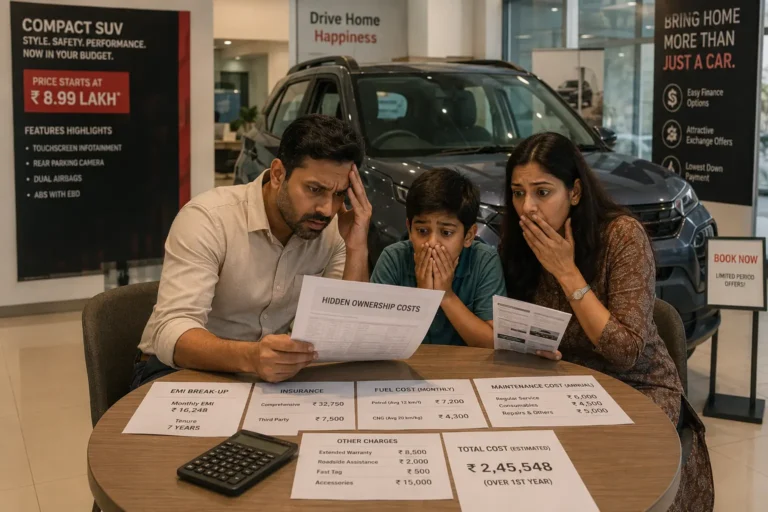
Most car buyers in India make the same costly mistake, they judge affordability only by the EMI. But the true total cost of car ownership in India goes far beyond your monthly loan payment and fuel bill. From insurance renewals and rising maintenance costs to depreciation that quietly eats away your car’s value, the real expense is often 30%–40% higher than what buyers initially expect. Understanding these hidden costs is the difference between a smart purchase and a long-term financial burden.
What most buyers underestimate before purchasing a car
The true cost of owning a car in India goes far beyond the EMI and fuel bill. Expenses like insurance renewals, depreciation, maintenance, parking, tolls, and loan interest quietly increase your monthly outflow by 25% to 35%. A car that “fits your EMI budget” can still strain your finances if these hidden costs are ignored.
Cost of car Ownership in India: Beyond Just Fuel and EMI
Walk into almost any dealership in India, and the first question is usually:
“Sir, what EMI are you comfortable with?”
That sounds convenient, but it’s one of the biggest financial traps in car buying.
A car isn’t just a one-time purchase or a monthly EMI. It’s an ongoing financial commitment that continues long after you leave the showroom. Between fuel bills, insurance renewals, servicing, tire replacements, tolls, parking fees, and depreciation, the real ownership cost is often far higher than buyers initially expect.
This is why smart buyers focus on the Total Cost of Ownership (TCO) instead of just the showroom price.
1. What Is the Total Cost of Ownership (TCO)?

Total Cost of Ownership (TCO) is the complete amount you spend on a car during the entire period you own it. It includes the purchase cost, loan interest, fuel, insurance, maintenance, parking, tolls, and depreciation minus the resale value.
In simple words:
TCO = Every rupee your car takes from your pocket over time.
For example:
- You buy a car for ₹10 lakh
- Spend ₹5 lakh on fuel and maintenance over 5 years
- Pay ₹2 lakh in loan interest and insurance
- Sell the car for ₹5 lakh
Your actual ownership cost isn’t ₹10 lakh — it’s closer to ₹12 lakh after adjusting for resale value.
Why TCO Matters
Most buyers compare:
- EMI
- Mileage
- Features
Very few calculate:
- Long-term maintenance
- Depreciation losses
- Running costs
- Interest burden
That’s where budgeting mistakes begin.
2. Why EMI Is Only Part of the Story
EMI only repays the loan. It does not include fuel, maintenance, insurance, parking, tolls, or depreciation.
This is why two people paying the same EMI can experience completely different financial pressure depending on how much they drive and maintain the car.
The Long-Tenure Trap
Many buyers choose:
- 6-year loans
- 7-year loans
- low down payments
because it reduces the EMI.
But longer tenure means:
- more total interest,
- higher insurance exposure,
- slower equity buildup,
- and higher overall ownership cost.
Example: ₹8 Lakh Loan at 9%
| Tenure | EMI | Total Interest |
|---|---|---|
| 4 Years | Lower overall cost | ~₹1.5 Lakh |
| 7 Years | Lower EMI | ~₹2.8 Lakh |
A “comfortable EMI” often hides a massive long-term interest burden.
3. Fuel Costs Over 5 Years
Fuel becomes one of the largest recurring ownership expenses, especially for Indian commuters driving daily in city traffic.
For someone driving:
- 1,000–1,200 km/month
- with petrol around ₹100+/liter
fuel spending alone can cross several lakhs within five years.
Estimated 5-Year Fuel Cost
| Vehicle Type | Avg Mileage | Approx 5-Year Fuel Cost |
|---|---|---|
| Petrol Hatchback | 15 km/l | ₹4–₹5 Lakh |
| Diesel SUV | 18 km/l | ₹3–₹4 Lakh |
| Hybrid Car | 24 km/l | ₹2–₹3 Lakh |
Choosing the right fuel type also plays a huge role in long-term ownership cost, especially when comparing maintenance, resale value, and yearly running distance. If you’re confused about fuel choice in 2026, read our detailed guide on diesel vs petrol ownership cost in India to understand which option makes better financial sense for your driving pattern.
Why Fuel Costs Rise Faster Than Expected
- traffic congestion,
- AC usage,
- rising fuel prices,
- aggressive driving habits,
- poor maintenance.
In cities like Bengaluru, Mumbai, and Delhi, stop-go traffic significantly reduces real-world mileage compared to claimed ARAI figures.
Most buyers discover that why real mileage is lower than ARAI mileage claims, especially in heavy Indian traffic and daily AC usage conditions.
4. Insurance Costs Most Buyers Ignore
Insurance is not a one-time expense. It is an annual recurring cost that continues throughout ownership.
Most buyers only notice the first-year insurance bundled into the on-road price.
But renewals continue every year.
Hidden Insurance Costs
- Zero-dep cover renewals
- Engine protection add-ons
- Return-to-invoice cover
- Flood protection in metro cities
- Rising third-party premiums
Typical Annual Insurance Costs
| Vehicle Segment | Annual Premium |
|---|---|
| Hatchback | ₹12,000–₹18,000 |
| Sedan | ₹18,000–₹28,000 |
| SUV | ₹25,000–₹45,000 |
Luxury vehicles can easily cross ₹1 lakh annually.
5. Maintenance and Service Expenses
Modern cars are cheaper to maintain early on, but ownership costs rise significantly after warranty periods end.
Most buyers only calculate scheduled service cost.
But real maintenance includes:
- tires,
- batteries,
- brake pads,
- suspension,
- clutch wear,
- AC repairs,
- wheel alignment,
- unexpected breakdowns.
Typical Ownership Timeline
| Year | Common Expenses |
|---|---|
| 1–2 | Basic servicing |
| 3–4 | Battery replacement |
| 4–5 | Tire replacement |
| 5+ | Suspension, clutch, AC work |
Hidden Maintenance Reality
A single unexpected repair can cost:
- ₹20,000 to ₹80,000+
especially in:
- turbo petrol cars,
- diesel SUVs,
- luxury vehicles.
6. Depreciation: The Biggest Hidden Expense

Depreciation is the reduction in your car’s market value over time, and it is usually the single largest ownership expense.
The moment a new car leaves the showroom, it loses value.
Typical Depreciation in India
| Ownership Year | Approx Value Retained |
|---|---|
| Year 1 | 80–85% |
| Year 3 | 65–70% |
| Year 5 | 50–55% |
Example
A ₹12 lakh SUV may only sell for:
- ₹6–₹7 lakh after five years.
That means:
- ₹5 lakh+ vanished through depreciation alone.
Cars With Better Resale Value
Brands that usually retain value better:
- Maruti Suzuki
- Toyota
- Honda
Cars with weaker resale:
- niche brands,
- luxury sedans,
- discontinued models.
7. Parking, Tolls, and Daily Usage Costs
Daily usage expenses quietly add thousands to your monthly ownership cost.
These include:
- parking fees,
- FASTag recharge,
- washing,
- accessories,
- traffic fines,
- society parking charges.
Common Monthly Expenses in Metro Cities
| Expense | Approx Monthly Cost |
|---|---|
| Parking | ₹1,000–₹4,000 |
| Tolls/FASTag | ₹500–₹3,000 |
| Car Cleaning | ₹500–₹1,500 |
| Accessories & Misc. | ₹500–₹2,000 |
For urban commuters, these “small” expenses become significant over time.
8. Comparing Hatchback vs SUV Ownership Cost

Estimated Monthly Ownership Comparison
| Expense Item | Hatchback (₹6L) | Compact SUV (₹12L) |
|---|---|---|
| EMI | ₹10,500 | ₹21,000 |
| Fuel | ₹6,000 | ₹8,500 |
| Insurance | ₹1,200 | ₹2,800 |
| Maintenance | ₹800 | ₹1,500 |
| Parking/Tolls | ₹1,000 | ₹2,000 |
| Total Monthly Cost | ₹19,500 | ₹35,800 |
The Reality
A buyer planning only for the EMI might think:
- ₹21k/month.
Actual ownership reality:
- closer to ₹36k/month.
That gap causes financial stress for many families.
9. The Psychological Mistake Most Buyers Make

Buyers often mistake “loan approval” for “affordability.”
Banks approve loans based on:
- income,
- credit score,
- repayment capacity.
But that does not mean the car comfortably fits your lifestyle.
Common Emotional Buying Mistakes
- buying bigger SUVs for status,
- stretching budget for sunroof/features,
- ignoring future fuel costs,
- underestimating maintenance,
- focusing only on monthly EMI.
Many first-time buyers underestimate how quickly hidden ownership costs accumulate beyond the showroom price and EMI. This detailed breakdown of the hidden costs of buying a car in India explains how fuel, insurance, depreciation, maintenance, and loan interest quietly increase your real monthly expenses.
This creates:
- investment delays,
- reduced savings,
- emergency fund pressure,
- “car-poor” lifestyle.
10. How to Calculate Real Car Affordability
Your total car expenses should ideally remain within 10–15% of your monthly take-home salary.
Practical Budget Rule
If your salary is:
- ₹1 lakh/month
then total ownership cost should stay around:
- ₹10k–₹15k/month ideally,
- ₹20k max for comfort.
Smart Ownership Planning Checklist
Before buying:
- Calculate total monthly cost
- Keep emergency savings intact
- Avoid zero-down-payment loans
- Compare insurance outside dealership
- Estimate 5-year fuel expense
- Research resale value
11. Ways to Reduce Total Ownership Cost
Smart Strategies That Actually Work
- Choose fuel-efficient vehicles
- Prefer shorter loan tenure
- Increase down payment
- Compare insurance annually
- Avoid unnecessary accessories
- Maintain tire pressure properly
- Service car on time
- Drive smoothly to reduce wear
Simple driving habit changes can significantly reduce monthly fuel spending and improve real-world mileage over time. Explore these practical ways to improve fuel efficiency to lower fuel costs and get better mileage in daily Indian driving conditions.
The Biggest Saver
Buying the “right-sized” car usually saves more money than chasing luxury features.
12. Is Car Ownership Worth It Financially?

Editorial Perspective: Strictly financially, a car is a depreciating asset. But real life is not just spreadsheets.
For Indian families, a car offers:
- convenience,
- safety,
- emergency mobility,
- travel flexibility,
- comfort during extreme weather.
The key is not avoiding car ownership.
The key is:
owning a car that supports your lifestyle without damaging your long-term finances.
Questions Buyers Commonly Ask Before Purchasing a Car
What is the total cost of ownership?
It includes all expenses related to owning a car:
- EMI,
- fuel,
- maintenance,
- insurance,
- depreciation,
- parking,
- tolls,
- and repairs.
Is EMI the biggest car expense?
Not always. Over time, fuel and depreciation can cost more than the EMI interest itself.
How much does a car cost monthly in India?
For most middle-class buyers:
- hatchbacks: ₹15k–₹20k/month,
- compact SUVs: ₹25k–₹40k/month.
What hidden expenses do car owners forget?
Most commonly:
- insurance renewal,
- tire replacement,
- battery replacement,
- parking fees,
- FASTag recharge,
- depreciation loss.
Is buying a car financially smart?
It can be — if ownership costs comfortably fit within your budget and do not interrupt your savings or investments.
Looking Beyond the Showroom Price
A car doesn’t become expensive when you buy it.
It becomes expensive slowly:
- at the fuel pump,
- during insurance renewal,
- inside service centers,
- and when resale value drops every year.
The smartest buyers are not the ones buying the most expensive car.
They are the ones who understand the full financial picture before signing the papers.
One Last Thought Before You Buy
A car should improve your life — not quietly consume your salary month after month.
Plan for the hidden costs today, and your ownership experience will feel rewarding instead of stressful.
The Bottom Line (Quick Summary)
The true cost of car ownership includes much more than EMI and fuel expenses. Indian car buyers must also budget for insurance renewals, maintenance, tire replacement, parking, tolls, loan interest, and depreciation. These hidden costs can increase total monthly ownership expenses by 25–35%, making Total Cost of Ownership (TCO) essential for realistic financial planning.
Helpful Resources
🏦 Reserve Bank of India (RBI)
Official regulator for banking rules, lending policies, and interest rate guidelines in India.
👉 https://www.rbi.org.in/
📊 TransUnion CIBIL
Check your credit score and understand how it impacts loan approval and interest rates.
👉 https://www.cibil.com/
🚗 SBI Auto Loans
Compare car loan options, interest rates, and eligibility from India’s largest public sector bank.
👉 https://sbi.co.in/web/personal-banking/loans/auto-loans
🏦 HDFC Bank Car Loans
Explore flexible financing options for new and used cars with private banking benefits.
👉 https://www.hdfc.bank.in/car-loan
🚘 ICICI Bank Vehicle Finance
Find competitive car loan plans, EMI calculators, and eligibility details.
👉 https://www.icicibank.com/personal-banking/loans/car-loan
Also Read: Diesel vs Petrol Cars: Which Makes Financial Sense in 2026?
Disclaimer: The figures and estimates mentioned in this article are for informational purposes only and may vary based on location, vehicle type, and market conditions.
In 2026, the diesel vs petrol debate is no longer just about mileage. Rising vehicle prices, stricter BS6 Phase 2 emission rules, resale uncertainty, and the growth of hybrid cars have completely changed the financial equation.
For most Indian buyers driving under 15,000 km annually, petrol cars now make more financial sense. Diesel still works for high-mileage highway users—but the break-even point is much farther away than it used to be.
Diesel vs Petrol Cars: Which Makes Financial Sense in 2026?
A few years ago, the answer was simple: buy diesel if you drive a lot. But in 2026, things are different.
Modern diesel engines are more expensive, more complex, and increasingly affected by emission regulations. At the same time, petrol engines and strong hybrids have become far more fuel-efficient, especially in city traffic.
So the smarter choice now depends less on “fuel type” and more on:
- your yearly running,
- where you drive,
- how long you keep the car,
- and future resale risks.
Petrol vs Diesel Cars: What’s the Real Difference?
Petrol cars are smoother, quieter, and better suited for city driving. Diesel cars offer stronger torque and better highway fuel efficiency, especially for heavier vehicles.
Petrol Cars
Best known for:
- smoother engine refinement
- lower vibration
- quieter cabin
- lower maintenance complexity
Diesel Cars
Known for:
- higher torque
- stronger highway pulling power
- better mileage
- better long-distance efficiency
What Changed in 2026?
Modern diesel vehicles now require:
- DPF systems
- AdBlue technology
- stricter BS6 Phase 2 compliance systems
This increases:
- servicing complexity
- ownership cost
- repair expenses
Fuel Prices in 2026: Is Diesel Still Much Cheaper?
The petrol-diesel price gap in India has narrowed significantly, reducing diesel’s traditional savings advantage.
| City | Petrol Price | Diesel Price |
|---|---|---|
| Delhi | ₹94–95/L | ₹87–88/L |
| Mumbai | ₹103–104/L | ₹90–91/L |
| Bengaluru | ₹102–103/L | ₹90–91/L |
Why This Matters
Earlier:
- diesel fuel was dramatically cheaper
Now:
- savings per liter are much smaller
- break-even periods are longer
- higher upfront diesel cost matters more

Mileage and Running Cost Comparison
Diesel cars still offer better mileage, but modern petrol and hybrid cars have reduced the gap significantly.
Many buyers also forget that official mileage claims rarely match real-world Indian driving conditions. Understanding the gap between claimed and actual fuel economy can help you estimate realistic running expenses more accurately. Read our detailed guide on ARAI mileage vs real mileage in India.
| Factor | Petrol | Diesel |
|---|---|---|
| City Mileage | 12–15 km/l | 16–18 km/l |
| Highway Mileage | 17–20 km/l | 22–24 km/l |
| Maintenance Cost | Lower | Higher |
| Purchase Price | Lower | Higher |
| Refinement | Better | Moderate |
| Best Use Case | City driving | Highway driving |

The Hybrid Problem for Diesel
Strong hybrids now deliver:
- 25–28 km/l in city traffic
- lower maintenance than diesel
- smoother driving experience
This has weakened diesel’s biggest advantage.
Which Has Lower Maintenance Costs?

Petrol cars are significantly cheaper and simpler to maintain.
Why Diesel Costs More
Diesel engines require:
- larger oil capacity
- expensive fuel filters
- turbo systems
- DPF maintenance
- AdBlue refills
Expensive Diesel Risks in 2026
Potential high-cost repairs include:
- DPF replacement
- injector servicing
- turbocharger repairs
- emission system faults
City Driving Problem
Short city trips often prevent diesel engines from properly regenerating the DPF system.
What About Resale Value in 2026?
Diesel resale values are becoming uncertain in major metro cities due to age restrictions and future regulation fears.
Delhi-NCR Impact
Diesel vehicles face:
- 10-year usage restrictions
- resale pressure after 5–6 years
- declining buyer confidence
Petrol Advantage
Petrol cars generally:
- retain broader resale appeal
- avoid diesel-ban concerns
- offer longer legal usage periods
Are Petrol Cars Better for City Driving?

Yes. Petrol and hybrid cars are now the best options for urban driving conditions.
Why Petrol Wins in Cities
Petrol cars:
- warm up faster
- feel smoother in traffic
- handle short trips better
- avoid DPF clogging risks
Traffic Reality in India
In stop-go traffic:
- diesel efficiency advantage reduces
- refinement becomes more important
- maintenance issues increase
Does Diesel Still Make Sense for Highway Drivers?

Yes. Diesel still performs exceptionally well for long-distance highway driving and heavy SUVs.
Where Diesel Still Wins
Best for:
- 1,500–2,000+ km monthly driving
- frequent highway travel
- heavy 7-seater SUVs
- towing or hill driving
Why Highway Users Prefer Diesel
Diesel engines provide:
- stronger torque
- relaxed cruising
- fewer fuel stops
- lower highway running cost
Break-Even Analysis: When Does Diesel Become Worth It?

In 2026, most buyers need very high annual running to justify diesel financially.
| Factor | Petrol SUV | Diesel SUV |
|---|---|---|
| On-Road Price | ₹14 Lakh | ₹16.5 Lakh |
| Price Difference | — | ₹2.5 Lakh |
| Monthly Fuel Cost | ₹9,500 | ₹6,500 |
| Monthly Savings | — | ₹3,000 |
| Break-Even Time | — | Nearly 7 Years |
Important Reality Check
If you:
- drive under 15,000 km yearly,
- keep cars for only 5 years,
diesel often never fully recovers its higher purchase cost.
Want to lower your monthly running cost regardless of fuel type? Explore these tips to improve fuel economy and increase your real-world mileage in Indian traffic conditions.
Are Hybrids and EVs Replacing Diesel?

For many urban buyers, yes.
Why Hybrids Are Growing Fast
Strong hybrids now offer:
- diesel-like efficiency
- lower maintenance
- smoother city driving
- fewer regulation concerns
EV Competition
Electric vehicles now offer:
- extremely low running cost
- city-friendly ownership
- lower servicing expenses
Diesel’s dominance is shrinking rapidly in urban markets.
Who Should Buy a Petrol Car in 2026?

Petrol Makes Sense For:
- city commuters
- low annual running
- occasional drivers
- buyers keeping cars under 7 years
- people prioritizing comfort and refinement
Ideal Annual Usage
Under:
- 12,000–15,000 km yearly
Who Should Still Buy a Diesel Car?
Diesel Makes Sense For:
- frequent highway users
- high-mileage drivers
- large SUV buyers
- long-distance commuters
- heavy commercial usage
Ideal Annual Usage
Usually:
- above 18,000–20,000 km yearly
Mistakes Buyers Still Make
Common Financial Mistakes
- buying diesel only for mileage
- ignoring higher EMI burden
- underestimating maintenance
- ignoring resale uncertainty
- overlooking DPF problems in city usage
Biggest Misconception
Better mileage alone does not automatically make diesel cheaper overall.
Common Questions Buyers Ask
Are diesel cars worth buying in 2026?
Only for high-mileage users regularly driving long distances.
Which is cheaper to maintain?
Petrol cars are cheaper and mechanically simpler.
Is diesel banned in India?
No, but Delhi-NCR has a 10-year restriction for diesel vehicles.
What annual running justifies diesel?
Typically above 18,000 km annually.
Are petrol cars better for city traffic?
Yes. They are smoother, quieter, and better suited for short-distance driving.
What Most Buyers Should Focus On Instead
Before choosing fuel type, calculate:
- annual running
- fuel spending
- maintenance costs
- insurance premiums
- resale expectations
- ownership duration
Mileage alone no longer tells the full story.
Smart buyers now evaluate the complete ownership picture including maintenance, depreciation, insurance renewals, and fuel expenses before choosing a fuel type. Here’s a detailed breakdown of the true cost of owning a car beyond EMI.
Also check: Petrol and Diesel fuel cost calculator
The Smarter Financial Choice in 2026
For most Indian buyers in 2026, petrol and hybrid cars are now the safer long-term financial decision. Diesel still works brilliantly for high-mileage highway drivers, but its traditional cost advantage has narrowed dramatically due to rising purchase prices, stricter emission systems, and uncertain resale value.
Many first-time buyers underestimate how quickly hidden ownership expenses add up after purchase. Beyond fuel savings, factors like servicing, depreciation, parking, and insurance renewals significantly impact long-term affordability. Learn more about the actual cost of car ownership in India before making your final decision.
Helpful Resources
The Real Secret to Better Mileage (In Short)
You can improve your car’s fuel efficiency by up to 20% through smoother driving, proper tire pressure, regular servicing, and avoiding unnecessary idling. In Indian traffic conditions, simple habits like maintaining steady speeds between 60–80 km/h and planning routes carefully can significantly reduce monthly fuel expenses.
7 Proven Tips to Increase Your Car Fuel Efficiency by 20%
With petrol and diesel prices staying painfully high in India, every extra kilometer per liter matters. The good news? You don’t need to buy a hybrid or electric vehicle to save money on fuel.
In most Indian cities, driving habits and vehicle maintenance affect mileage far more than people realize.
Many drivers also misunderstand why their real-world mileage differs so much from the company-claimed figures. Understanding the gap between certified and actual mileage helps set realistic fuel cost expectations. Read our detailed guide on ARAI mileage vs real mileage in India.
Small changes—like smoother acceleration, proper tire pressure, and avoiding unnecessary idling—can noticeably reduce your monthly fuel bill.
Why Fuel Efficiency Matters More Than Ever
Improving fuel efficiency is one of the easiest ways to reduce monthly commuting costs in India. Even a small mileage improvement can save thousands of rupees every year.
Why Better Mileage Matters
- Lower monthly fuel expenses
- Reduced engine stress
- Better long-term maintenance costs
- Lower carbon emissions
- Higher resale value due to healthier engine condition
Real Savings Potential
For many Indian drivers:
- 10–20% mileage improvement can save ₹15,000–₹25,000 yearly
- Daily commuters benefit the most
- City drivers usually waste more fuel than highway drivers
Maintain Proper Tire Pressure

Underinflated tires increase rolling resistance, forcing the engine to work harder and consume more fuel.
Keeping tires properly inflated can improve mileage by 3–5%.
Why Tire Pressure Affects Mileage
Soft tires create:
- More friction with the road
- Higher fuel consumption
- Uneven tire wear
- Reduced handling performance
Smart Tire Habits
- Check tire pressure weekly
- Follow manufacturer PSI recommendations
- Inspect pressure before long drives
- Refill air when temperatures change significantly
Practical Example
Driving with low tire pressure is similar to cycling on soft tires—you use more energy to move the same distance.
Avoid Aggressive Driving and Sudden Braking

Rapid acceleration and hard braking waste fuel quickly. Smooth driving is one of the fastest ways to improve fuel economy.
Fuel-Efficient Driving Habits
- Accelerate gradually
- Maintain consistent speed
- Avoid unnecessary overtaking
- Coast toward red lights when possible
- Keep RPM between 1,500–2,500
Highway vs City Driving
Aggressive driving can reduce mileage by:
- 15% on highways
- 5–10% in city traffic
Reduce Excess Weight in Your Car
Extra weight forces your engine to burn more fuel. Even unnecessary luggage in your boot affects efficiency.
Hidden Weight Problems
Common fuel-wasting items include:
- Heavy tool kits
- Sports equipment
- Unused roof carriers
- Water cans
- Excess luggage
Why Roof Carriers Hurt Mileage
Roof racks increase:
- Aerodynamic drag
- Highway fuel consumption
- Wind resistance
Service Your Car Regularly

A well-maintained car consumes less fuel because the engine operates more efficiently.
Important Maintenance Areas
Air Filters
Dirty air filters restrict airflow and reduce combustion efficiency.
Engine Oil
Using the correct engine oil reduces internal friction.
Wheel Alignment
Poor alignment increases rolling resistance.
Spark Plugs
Faulty spark plugs reduce fuel combustion efficiency.
Expert Insight
“Most mileage-related problems in Indian cars are caused by delayed maintenance and aggressive city driving—not engine design. Simple maintenance routines can significantly improve fuel economy over time.”
Avoid Excessive Idling

Idling burns fuel without moving the vehicle. In heavy Indian traffic, excessive idling can quietly increase fuel expenses.
When to Switch Off the Engine
If you stop for:
- more than 10–20 seconds,
- switching off the engine is usually more fuel-efficient.
Common Fuel-Wasting Situations
- Long traffic signals
- Waiting with AC on
- School pickup lines
- Railway crossings
Important Note
Modern cars do not require long warm-up periods before driving.
Use the Right Gear and Driving Speed
Driving at the wrong speed or gear forces the engine to consume extra fuel unnecessarily.
Best Mileage Speed Range
For most Indian cars:
- 60–80 km/h delivers optimal fuel efficiency
- Very high speeds sharply increase fuel consumption
Smart Gear Habits
- Shift gears smoothly
- Avoid over-revving
- Use higher gears whenever possible without straining the engine
Plan Routes and Avoid Traffic
Traffic congestion causes repeated acceleration and braking, which significantly reduces mileage.
Smart Route Planning Tips
- Use navigation apps before driving
- Avoid peak-hour traffic
- Combine multiple errands into one trip
- Choose smoother roads over shorter congested routes
Why Short Trips Waste Fuel
Cold engines consume more fuel before reaching optimal operating temperature.
Real Fuel Savings Example for Indian Drivers

Here’s a practical example for a petrol hatchback owner driving 1,000 km monthly.
| Feature | Before Habits | After Smart Habits |
|---|---|---|
| Average Mileage | 14 km/l | 17 km/l |
| Monthly Fuel Use | 71.4 L | 58.8 L |
| Monthly Fuel Cost (@ ₹105/L) | ₹7,497 | ₹6,174 |
| Monthly Savings | — | ₹1,323 |
Annual Savings
Improving mileage from 14 km/l to 17 km/l can save:
- nearly ₹16,000 per year without changing your car.
Fuel savings become even more important when you consider the broader long-term expenses of owning a vehicle. Here’s a detailed breakdown of the true cost of owning a car beyond EMI, including maintenance, depreciation, insurance, and hidden monthly expenses.
Check out: Fuel cost calculator
Common Mileage Mistakes Drivers Make
Many drivers unknowingly waste fuel through poor habits and delayed maintenance.
Biggest Fuel-Wasting Mistakes
- Driving aggressively
- Riding the clutch in traffic
- Ignoring tire pressure
- Delaying servicing
- Overusing AC in traffic
- Using low-quality fuel
- Ignoring warning lights
Can These Tips Really Improve Mileage by 20%?
Yes—but results depend on your current driving habits and vehicle condition.
Realistic Expectations
You may see:
- 15–25% gains if current habits are poor
- 5–10% gains if you already drive efficiently
Biggest Improvement Areas
The highest fuel savings usually come from:
- smoother acceleration
- avoiding idling
- regular servicing
- proper tire pressure
Common Questions About Fuel Efficiency
-
How can I improve my car mileage quickly?
The fastest improvements come from maintaining tire pressure, driving smoothly, and reducing unnecessary idling.
-
Does AC reduce fuel efficiency?
Yes. In heavy traffic, AC usage can reduce mileage by 10–20%.
Fuel efficiency also varies significantly depending on your vehicle type and engine choice. If you’re planning a new purchase, check this detailed diesel vs petrol cars financial comparison to understand which fuel type makes better financial sense in 2026. -
What speed gives the best mileage?
Most Indian cars achieve best efficiency between 60–80 km/h.
-
Does tire pressure really affect fuel economy?
Absolutely. Low tire pressure increases rolling resistance and fuel consumption.
-
Can servicing improve mileage?
Yes. Regular servicing improves engine efficiency and reduces fuel waste.
Simple Habits That Save Fuel Every Day
- Check tire pressure regularly
- Accelerate gently
- Avoid carrying unnecessary weight
- Turn off engine during long stops
- Service your car on schedule
- Plan routes in advance
What You Should Remember About Fuel Efficiency
- Smooth driving saves more fuel than aggressive acceleration
- Proper tire pressure improves both mileage and safety
- Delayed maintenance quietly reduces fuel economy
- Heavy traffic and idling are major fuel wasters
- Small driving changes can save thousands annually
Making Fuel-Saving Habits Work Long-Term

Many car owners focus only on fuel savings while ignoring other hidden ownership expenses like depreciation, insurance renewals, servicing, and loan interest. Understanding the actual cost of car ownership in India helps create a more realistic long-term budget.
Improving fuel efficiency isn’t about one dramatic change, it’s about consistent habits. In Indian driving conditions, smoother driving, better route planning, and timely servicing can noticeably reduce your monthly fuel expenses while keeping your car healthier for years.
Helpful Resources
- IndianOil Fuel Advice
- Maruti Suzuki Driving Tips
- Hyundai India Car Care Guide
- Tata Motors Service Tips
Also Read: Your Car Is Costing You More Than You Think (Here’s the Real Math)
The Real Cost of Owning a Car (In Short)
The true cost of car ownership includes the on-road price plus recurring expenses like fuel, insurance premiums, scheduled maintenance, and depreciation. In India, hidden costs typically add 25% to 40% to your initial monthly EMI budget. To calculate the real cost, you must look beyond the showroom price and account for the vehicle’s value loss over time.
The True Cost of Ownership: Hidden Expenses of Buying a Car
Most car buyers in India focus on one number: the EMI. We walk into a showroom, see a price tag of ₹8 Lakh, and if the monthly payment fits our salary, we sign the papers. But the “sticker price” is just the tip of the iceberg.
Owning a car is a long-term financial commitment. Between the moment you drive it off the lot and the day you sell it, you will likely spend thousands of rupees on things you never planned for—like surging insurance premiums, RTO charges, and the silent wealth-killer known as depreciation.
1. What Is the True Cost of Car Ownership?
The true cost of car ownership (Total Cost of Ownership or TCO) is the total amount of money spent to acquire, operate, and maintain a vehicle over its entire lifespan. It combines the purchase price, loan interest, and running expenses minus the final resale value.
Key Components of TCO:
- Fixed Costs: Loan interest, insurance, and road tax.
- Variable Costs: Fuel, service charges, tires, and parking.
- Economic Cost: Depreciation (the loss in the car’s market value).
2. On-Road Price vs. Actual Ownership Cost
The Ex-Showroom price is what the manufacturer charges for the car. The On-Road price includes mandatory costs like RTO registration, Road Tax, and Insurance. However, the Actual Ownership Cost is much higher because it includes 5–7 years of fuel and maintenance.
In cities like Bangalore or Mumbai, the gap between the showroom price and the on-road price can be as high as 15-20% due to high state road taxes. If you don’t factor in these “entry costs,” your initial budget will be blown before you even hit the highway.
3. Hidden Costs You Don’t Think About Before Buying a Car
When you buy a car, you aren’t just buying a machine; you are subscribing to a lifestyle of micro-transactions.
Many of these hidden expenses become even more unpredictable when fuel efficiency varies from what manufacturers claim. Real-world mileage in Indian conditions is often much lower than advertised figures. Understand this gap in detail with ARAI mileage vs real mileage in India.
The “Invisible” Expense List:
- Insurance Renewals: While the first year is often bundled, subsequent Year-on-Year premiums (especially for Zero-Depreciation covers) are a significant annual hit.
- Fuel Inflation: Petrol and Diesel prices fluctuate. A 10% hike in fuel can disrupt your monthly savings.
- Scheduled Maintenance: Beyond oil changes, cars need brake pad replacements, wheel alignment, and battery swaps every few years.
- Tolls and Parking: Frequent highway travel or paying for monthly parking in congested cities like Delhi or Pune adds up to a hidden annual fortune.
- Consumables: Windshield fluid, car wash services, and cabin air filters are small but constant leaks in your wallet.
4. Car Loan Interest: The Biggest Hidden Cost
Car loan interest is the “extra” money you pay the bank for the privilege of borrowing. Over a 5 to 7-year tenure, the interest can add ₹2 Lakh to ₹4 Lakh to the total cost of a mid-sized car.
Real-Life Financial Example:
If you take a loan of ₹8,00,000 at an interest rate of 9% for 5 years:
- Monthly EMI: ₹16,607
- Total Interest Paid: ₹1,96,420
- Total Repayment: ₹9,96,420
By the time you own the car fully, you’ve paid nearly ₹2 Lakh extra just to the bank. This is why choosing the right tenure is critical.
Once fuel and loan costs are combined, choosing the right fuel type becomes a major factor in long-term affordability. Diesel may look cheaper on paper, but real ownership costs depend heavily on usage patterns. Compare both options in our guide on diesel vs petrol cars in India 2026.
5. Depreciation: The Silent Money Loss
Depreciation is the rate at which your car loses its market value. In India, a new car loses about 10-15% of its value the moment it is registered and driven out of the showroom.
Why Depreciation Matters:
- The 50% Rule: By the end of year 5, most cars are worth only 50-60% of their original on-road price.
- Resale Impact: Brands like Maruti Suzuki and Toyota hold value better (slower depreciation), while luxury or less popular brands may depreciate much faster.
- Opportunity Cost: The money “lost” to depreciation could have earned interest if invested in a mutual fund or FD.
6. Insurance and Maintenance Costs Over Time
A car is cheapest to maintain in its first two years (under warranty). From the 3rd to 5th year, costs escalate as parts wear out and the manufacturer’s free services end.
- Insurance Renewal: As your car ages, its IDV (Insured Declared Value) drops, but the “Third Party” component of insurance often increases by government mandate.
- The Major Service: Typically, at the 40,000 km or 50,000 km mark, cars require “Major Services” involving timing belt checks, coolant flushes, and tire sets, which can cost ₹20,000–₹40,000 in one go.
7. Monthly Cost of Owning a Car in India (Real Example)
Let’s look at the monthly burden of owning a ₹10 Lakh SUV (On-Road) in a typical Indian metro:
| Expense Category | Estimated Monthly Cost |
| Loan EMI (₹8L Loan) | ₹16,600 |
| Fuel (1,000 km/month) | ₹7,500 |
| Insurance (Annual spread) | ₹2,500 |
| Maintenance & Cleaning | ₹1,500 |
| Parking & Tolls | ₹1,000 |
| TOTAL MONTHLY COST | ₹29,100 |
The Reality Check: Even though your EMI is only ₹16.6k, the car actually “costs” you nearly ₹30,000 every month.
This monthly cost becomes even more accurate when you include hidden expenses like depreciation, insurance renewal, and servicing. Explore the full breakdown in cost of car ownership in India beyond EMI.
8. How to Reduce Car Ownership Costs
You don’t have to go broke to stay mobile. Here is how to keep the TCO low:
- Choose High Mileage: Opt for cars with high ARAI-certified mileage to cut fuel bills.
- Compare Insurance: Never renew with the dealer blindly. Use platforms like PolicyBazaar or Acko to save up to 40%.
- Timely Servicing: Skipping a ₹5,000 service today can lead to a ₹50,000 engine repair tomorrow.
- Drive Smoothly: Hard braking and rapid acceleration reduce tire life and fuel efficiency.
One of the easiest ways to reduce overall ownership cost is improving fuel efficiency through better driving habits and maintenance. You can apply these practical strategies from tips to increase car fuel efficiency in India.
9. Common Mistakes Car Buyers Make
- Focusing Only on EMI: If you can afford the EMI but not the fuel, the car will stay in the garage.
- Ignoring the Resale Value: Buying a “niche” car might be fun, but if no one wants to buy it second-hand, your cost of ownership skyrockets.
- Skipping the Insurance “Add-ons”: Not taking “Engine Protect” or “Return to Invoice” in flood-prone cities like Chennai or Mumbai can be a million-rupee mistake.
10. Is Buying a Car Financially Worth It?
Final Editorial Take: Financially, a car is a depreciating asset. It rarely “makes money.” However, it provides utility, safety, and freedom.
Buying a car makes sense if the monthly TCO is less than 15-20% of your take-home pay. If the “Hidden Costs” push you beyond that, you might be better off using ride-sharing apps or public transport for a few more years.
To calculate your exact monthly car expense before making a purchase decision, use our free tools like the mileage cost calculator and monthly car expense calculator.

What You Should Remember Before Buying a Car
- On-Road is just the start: Factor in at least 25% extra for monthly running costs.
- Interest adds up: A 5-year loan can cost you ₹2 Lakh+ in pure interest.
- Depreciation is real: Your car loses value every single day, even if it’s parked.
- Maintenance spikes: Budget for higher repairs after the 3rd year of ownership.
Common Questions About Car Ownership Costs
Q1. What is the real cost of owning a car in India?
The real cost includes the EMI, fuel, insurance, maintenance, and depreciation. For a mid-range car, this usually totals between ₹25,000 and ₹35,000 per month.
Q2. Is EMI the only cost of buying a car?
No. EMI only covers the loan. You must also account for fuel, annual insurance renewals, RTO taxes, and periodic servicing.
Q3. How much does a car cost per month in India?
On average, a small hatchback costs ₹15k–₹20k/month, a sedan/compact SUV costs ₹25k–₹35k/month, and luxury cars can exceed ₹70k/month.
Q4. What is the biggest hidden cost in car ownership?
Depreciation is the largest hidden cost, as it can quietly wipe out 50% of your car’s value in just 5 years.
Q5. How much does car maintenance cost yearly?
For most Indian cars, scheduled maintenance costs between ₹8,000 and ₹15,000 per year for the first 3-5 years.
What You Should Remember Before Buying a Car
The true cost of car ownership goes beyond the purchase price, including EMI interest, fuel, insurance, and maintenance. In India, a car’s value also depreciates by roughly 50% in five years. Understanding these hidden expenses helps buyers budget for the real monthly impact on their finances.
Want a full breakdown of all ownership costs before buying a car? Explore our complete automotive tools hub at car ownership cost calculators and tools.
Your CIBIL score can decide whether your car loan gets approved within hours or rejected instantly. In India, banks and NBFCs use this 3-digit credit score to measure repayment risk, determine interest rates, and calculate loan eligibility.
A score above 750 usually unlocks lower EMIs, faster approvals, and better loan offers. Meanwhile, low scores can lead to higher interest rates, larger down payments, or outright rejection.
Quick Summary for Busy Readers
- A 750+ CIBIL score gives you the best car loan offers.
- Scores below 650 may result in higher interest rates or rejection.
- Banks like SBI, HDFC Bank, and ICICI Bank prioritize strong credit profiles.
- NBFCs may approve low-score borrowers but often charge higher rates.
- Improving your score before applying can save lakhs in interest costs.
What Is a CIBIL Score?
A CIBIL score is a 3-digit credit score ranging from 300 to 900 maintained by TransUnion CIBIL. It reflects your repayment history, credit card usage, existing EMIs, and loan behavior.
The higher your score, the more trustworthy you appear to lenders.
Why Your Credit Score Matters
Banks use your score to evaluate:
- Repayment discipline
- Existing debt burden
- Loan default probability
- Financial stability
- Overall creditworthiness
What Is Considered a Good CIBIL Score for a Car Loan?
A good CIBIL score for a car loan in India is generally considered 750 or above. Borrowers in this range usually receive:
- Faster approvals
- Lower interest rates
- Higher loan amounts
- Flexible repayment terms
Understanding how lenders evaluate loan applications can also help you reduce your overall borrowing cost. You can explore proven strategies in our guide on tips to get the lowest car loan, which explains how to secure better interest rates and EMI offers.
Why Banks Check Your Credit Score Before Approving a Car Loan
Banks check your credit score to reduce lending risk. Since car loans usually run for 3 to 7 years, lenders want confidence that borrowers will pay EMIs consistently.
Why Credit Scores Matter to Lenders
1. Predicting Default Risk
Borrowers with strong repayment histories statistically default less often.
2. Faster Loan Processing
High-score borrowers often qualify for:
- Instant car loan approval
- Pre-approved offers
- Reduced documentation
3. Better Profitability
Low-risk borrowers help banks maintain healthy loan portfolios.
Expert Insight
“Most Indian banks classify borrowers above 750 as low-risk applicants. Even a 50-point increase in your CIBIL score can significantly reduce your total car loan interest burden over five years.”
Minimum CIBIL Score Required for Auto Loan Approval in India
Most banks prefer applicants with a CIBIL score of 750 or above. However, some NBFCs may approve borrowers with scores between 600 and 700 under stricter conditions.

CIBIL Score Range Breakdown
| CIBIL Score Range | Approval Chances | Typical Loan Terms |
|---|---|---|
| 750–900 | Excellent | Lowest rates, instant approvals |
| 700–749 | Good | Easy approval, standard rates |
| 650–699 | Moderate | Higher rates, stricter checks |
| Below 650 | Weak | Possible rejection or expensive financing |
Which Banks Offer Car Loans for Low CIBIL Scores?
Traditional banks prefer higher scores, but several NBFCs and selective lenders offer financing options to borrowers with weaker credit profiles.
Comparison Table
| Bank/NBFC | Preferred CIBIL Score | Approval Speed | Interest Benefit |
|---|---|---|---|
| SBI | 750+ | High | Excellent |
| HDFC Bank | 725+ | Very Fast | Strong |
| ICICI Bank | 700+ | Fast | Moderate |
| Bajaj Finance | 650+ | Flexible | Higher Rates |
| Mahindra Finance | 650+ | Moderate | Flexible Approval |
How Different Credit Score Ranges Affect Interest Rates
Your credit score directly impacts your car loan interest rate. Higher-risk borrowers are charged higher interest to compensate lenders for potential defaults.
Even after getting a good loan rate, your overall monthly budget depends heavily on running costs. To understand real ownership impact beyond EMI, read cost of car ownership in India beyond EMI.
Example of Interest Rate Difference
Imagine a ₹10 lakh car loan for 5 years:
| Credit Score | Interest Rate | EMI | Total Interest Paid |
|---|---|---|---|
| 800+ | 8.8% | ₹20,600 | ₹2.36 lakh |
| 650 | 11.5% | ₹21,990 | ₹3.19 lakh |
Impact of a Low Score
A weak score could cost nearly:
- ₹83,000+ extra interest
- Higher processing fees
- Lower approved loan amount
Real-World Example Scenario
Example 1: Strong Credit Profile
Rahul earns ₹65,000 monthly and has:
- CIBIL score: 782
- Existing EMI: ₹8,000
- Stable private-sector job
He applies for a ₹9 lakh car loan.
Because of his strong profile:
- SBI offers 8.9% interest
- Loan approved within 24 hours
- Lower processing fees
Example 2: Weak Credit Profile
Aman has:
- CIBIL score: 638
- Multiple delayed credit card payments
- Existing personal loan
He receives:
- 11.5% interest
- Lower loan eligibility
- Requirement for co-applicant
- Larger down payment demand
Can You Get a Car Loan With a Low CIBIL Score?
Yes, borrowers with low CIBIL scores can still get car loans, but approval becomes harder and borrowing costs increase significantly.
Options for Low-Score Borrowers
Apply Through NBFCs
NBFCs often have more flexible approval criteria.
Add a Co-Applicant
A co-borrower with a strong score improves approval chances.
Increase Down Payment
Paying 40–50% upfront reduces lender risk.
Show Stable Income
Provide:
- Salary slips
- Bank statements
- Income tax returns
- Form 16
What Is Considered a Bad Credit Score for Vehicle Finance?
A CIBIL score below 650 is generally considered poor for vehicle finance. Borrowers in this category are viewed as high-risk applicants.
Problems Faced by Low-Score Borrowers
- High interest rates
- Loan rejection
- Lower approved amount
- Strict verification
- Requirement of guarantor
Factors Other Than CIBIL Score That Affect Auto Loan Approval
Your credit score is important, but lenders also analyze income stability, debt obligations, and employment profile.

Important Non-Credit Factors
Income Level
Higher salaries improve repayment confidence.
Debt-to-Income Ratio
Banks avoid lending if too much income already goes toward EMIs.
Employment Stability
Applicants working in reputed companies or government sectors are often preferred.
Residential Stability
Long-term residence history improves credibility.
Age Profile
Applicants nearing retirement may face lower eligibility.
Does a Car Loan Increase Your CIBIL Score?
Yes, responsibly repaying a car loan can improve your CIBIL score over time.
Once your loan is approved, it’s important to also understand how vehicle choice impacts long-term costs. For example, deciding between fuel types plays a major role in monthly expenses—read our comparison on ev vs petrol cars India 2026.
How It Helps
Timely EMI payments demonstrate:
- Financial discipline
- Responsible borrowing behavior
- Credit management ability
A successfully closed car loan strengthens your long-term credit profile.
How to Improve Your CIBIL Score Before Applying
Improving your score before applying can significantly increase approval chances and reduce borrowing costs.

Steps to Improve Your Score
1. Pay All EMIs on Time
Payment history is the biggest scoring factor.
2. Reduce Credit Card Utilization
Keep usage below 30% of your limit.
3. Avoid Multiple Loan Applications
Too many hard inquiries reduce your score.
4. Correct Errors in Your Credit Report
Check your report for:
- Duplicate loans
- Incorrect overdue amounts
- Closed loans marked active
5. Clear Existing Debt
Reducing liabilities improves your debt-to-income ratio.
Common Mistakes That Hurt Your Car Loan Approval
Small financial mistakes can significantly reduce your chances of getting approved for an auto loan.
Many buyers also miscalculate real-world running expenses, especially fuel efficiency differences. Learn how mileage impacts long-term budgeting in ARAI mileage vs real mileage India.
Mistakes to Avoid
- Applying to multiple banks simultaneously
- Missing recent credit card payments
- Taking a personal loan before car loan application
- Ignoring errors in your CIBIL report
- Maxing out credit card limits
- Frequently changing jobs
- Hiding existing liabilities
Common Reasons Auto Loans Get Rejected
Loan rejections usually happen because lenders detect financial instability or high repayment risk.
Top Rejection Reasons
Settled Loan Accounts
“Settled” status negatively impacts trust.
Excessive Existing EMIs
High debt obligations reduce affordability.
Poor Credit History
Late payments and defaults are major red flags.
New-to-Credit (NTC) Profile
No borrowing history makes risk assessment difficult.
Can a Rejected Auto Loan Affect Your Credit Score?
Yes, repeated loan rejections can indirectly affect your score because each application creates a hard inquiry on your credit report.
Why Multiple Rejections Hurt
Too many applications suggest:
- Credit desperation
- Financial stress
- High borrowing dependency
This can reduce lender confidence.
How Much CIBIL Score Is Needed for a Used Car Loan?
Used car loans often require slightly higher creditworthiness because lenders consider second-hand vehicles riskier assets.
Before finalizing any vehicle purchase, it’s also important to evaluate total ownership expenses, not just financing. Read our detailed breakdown of true cost of car ownership hidden expenses India.
Typical Requirement
Most lenders prefer:
- 700+ score for used car loans
- Stable income proof
- Larger down payment
Interest rates on used car loans are usually higher than new car financing.
Tips to Increase Your Car Loan Approval Chances
Strategic financial preparation can dramatically improve your approval odds.
Your financial planning doesn’t stop at loan approval. Daily usage costs like fuel efficiency also matter significantly. Check our guide on increase car fuel efficiency tips India.
Smart Approval Tips
- Check your score 3 months early
- Maintain healthy bank balance
- Avoid unnecessary debt
- Choose affordable EMI tenure
- Compare multiple lenders carefully
- Keep all KYC and income documents ready
Common Questions About CIBIL Score and Car Loans
What is the minimum CIBIL score for a car loan?
Most banks prefer a score of 750 or above for faster approvals and lower interest rates.
Does checking my own CIBIL score reduce it?
No. Self-checks are soft inquiries and do not affect your score.
Can I get a car loan with a 600 CIBIL score?
Yes, some NBFCs may approve your application, but rates may be higher.
Is CIBIL more important than salary for car loans?
Both matter. A high salary helps, but a poor score can still lead to rejection.
How long does it take to improve a CIBIL score?
Meaningful improvement usually takes 3–6 months of disciplined repayment behavior.
Helpful Resources
What You Should Remember
- A 750+ CIBIL score significantly improves your chances of fast car loan approval.
- Higher credit scores help you secure lower interest rates and affordable EMIs.
- Scores below 650 may lead to stricter loan conditions or rejection.
- Banks like SBI, HDFC Bank, and ICICI Bank prefer applicants with strong repayment history.
- Maintaining timely EMI and credit card payments can improve your score over time.
- NBFCs may offer financing for low-score borrowers but often charge higher interest rates.
- Smart buyers always evaluate total ownership cost before applying for any loan. You can calculate your real monthly impact using our detailed guide on cost of car ownership in India beyond EMI.
Final Thoughts on CIBIL Score and Car Loans
Your CIBIL score can directly influence your car loan approval, interest rate, and repayment terms. Maintaining a healthy credit history before applying not only improves approval chances but can also reduce the total cost of financing your vehicle.
Also Read: Tips to Get the Lowest Car Loan Interest Rate in 2026
2026 City Commuter’s Dilemma: EV or Petrol?
You’re sitting in bumper-to-bumper traffic. The AC is humming, and you’re watching the fuel needle on your dashboard slowly dip while petrol prices hover stubbornly above ₹110. In the lane next to you, a Tata Nexon.ev glides ahead in total silence, no tailpipe smoke, and seemingly no stress.
By 2026, the question isn’t just about “going green”—it’s about your wallet. Choosing a car today is a math problem mixed with a lifestyle choice. If your daily life involves a 30-to-50 km crawl through city arteries like Mumbai, Delhi, or Bangalore, the “EV vs Petrol” debate is likely the biggest financial decision you’ll face this year.
⚡ Key Takeaways for 2026
- The Savings King: EVs cost ₹1.2–₹1.5 per km, while petrol cars cost ₹8.5–₹11 per km.
- The Magic Number: The financial break-even point now happens at approximately 35,000 to 40,000 km.
- Hidden Reality: EVs save on fuel but cost more in tyres and insurance.
- The Verdict: High-mileage city drivers with home charging should go Electric; low-mileage drivers without plug access should stick to Petrol.
1. EV vs Petrol: The 2026 Core Comparison
In 2026, the Indian market is no longer in its “early adopter” phase. Giants like Tata Motors, MG Motor India, and Maruti Suzuki have flooded the streets with reliable options. But how do they stack up in the gritty reality of city traffic?
Performance in Stop-and-Go Traffic
A petrol engine is at its most inefficient when idling. Every minute you spend at a red light, you are burning money. In contrast, EVs like the MG ZS EV or the Tata Tiago.ev use almost zero energy when stationary.
Entity Spotlight: Why 2026 is Different
- Tata Motors: With the Nexon.ev and Punch.ev, they have mastered the “city-sized” SUV.
- MG Motor India: The Comet EV and Windsor EV have redefined what a compact urban runabout looks like.
- Maruti Suzuki: The launch of the eVX has finally brought the reliability and service network of Maruti into the electric era.

Refueling vs. Charging Convenience
Petrol still wins on pure speed (5 minutes at a pump). However, EV owners with a home charger—like the 7.2kW AC units provided by MG or Tata—experience “smartphone-like” convenience. You wake up every morning with a full battery, completely bypassing the petrol station queue.
2. The Break-Even Point: When Does an EV Become Cheaper?
The EV break-even point in 2026 is approximately 35,000–40,000 km of driving. Because EVs carry a “Green Premium” (higher upfront cost), you need to know exactly when your fuel savings will pay back that difference.
Before making a final decision, it’s also important to understand how financing costs impact your overall ownership budget. Smart buyers often reduce interest burden using strategies explained in tips to get the lowest car loan, which can significantly improve long-term affordability.
The Math of the Threshold
In 2026, the average price gap between a petrol car and its EV counterpart (e.g., a top-end petrol SUV vs. a Tata Nexon.ev) is roughly ₹3,50,000 to ₹4,00,000.
- Average Savings per KM: ₹7.50 (Petrol @ ₹9/km vs EV @ ₹1.5/km).
- Break-Even Calculation: ₹3,75,000 (Price Gap) ÷ ₹7.50 (Savings) = 50,000 km.

However, when you factor in the lower maintenance costs and government subsidies (state-specific road tax waivers), that magic number drops to 35,000–40,000 km.
The Mileage Rule of Thumb
- Under 800 km/month: It may take you 6+ years to break even. Petrol or a Maruti Suzuki hybrid is much more logical here.
- Over 1,200 km/month: You will hit the break-even point in less than 3 years. From Year 4 onwards, you are effectively “earning” ₹10,000 every month in fuel savings.
3. EV vs Petrol: Hidden Costs Nobody Talks About
Everyone talks about fuel savings, but to make an informed decision, you need to look at the hidden costs that impact long-term ownership.
- The “Torque Tax” on Tyres: EVs are heavier due to battery packs and deliver 100% of their torque instantly. This is great for overtakes, but it means EV tyres wear out about 15–20% faster than petrol car tyres.
- Insurance Differences in 2026: Because EVs have a higher starting price (IDV) and specialized battery packs, comprehensive insurance premiums are generally 15–25% higher than their petrol equivalents.
- Battery Replacement Psychology: It’s rare for a modern battery to fail completely. However, the fear of battery degradation affects the used car market. As an EV approaches the end of its 8-year warranty, buyers become hesitant, which can steepen depreciation.
- Resale Timing Strategy:
- For EVs: The smart move is to sell around Year 5 or 6, while the battery still has solid warranty coverage left, guaranteeing a higher resale value.
- For Petrol: Sell before the 10-year mark (crucial in places like Delhi/NCR) or right before a major milestone service (like 80,000 km) to avoid hefty maintenance bills.
- These hidden ownership expenses become even more important when you compare them with the full financial picture of a car, not just EMI or fuel savings. You can understand the complete breakdown in cost of car ownership in India beyond EMI, which explains real monthly cost pressure for Indian buyers.
4. 5-Year Total Cost Comparison (Real-World Estimate)
To help you visualize the long-term impact, here is a comparison between a standard mid-segment petrol car and a mid-range EV over 5 years and 60,000 km.
| Cost Component | Petrol Car (Mid-SUV) | Electric Vehicle (EV) |
| Purchase Price (On-Road) | ₹13,50,000 | ₹17,50,000 |
| Fuel / Electricity (5 Yrs) | ₹5,40,000 | ₹84,000 |
| Maintenance & Service | ₹65,000 | ₹18,000 |
| Insurance (5 Years) | ₹1,10,000 | ₹1,35,000 |
| Estimated Resale (Yr 5) | – ₹7,00,000 | – ₹8,50,000 |
| TOTAL NET COST | ₹13,65,000 | ₹11,37,000 |
| Cost per km (Final Avg) | ₹9.00 / km | ₹1.40 / km |
Cost differences also vary significantly depending on fuel type, driving patterns, and maintenance needs. For a deeper comparison of long-term fuel economics, check diesel vs petrol cars India 2026, which breaks down real-world efficiency and ownership cost differences.
EVs are best for high-mileage urban users with home charging. Petrol remains better for low-mileage or infrastructure-limited users.
The Result: Even with a much higher starting price and slightly higher insurance, the EV saves you approximately ₹2.28 Lakh over five years.
Financing and ownership costs are closely connected, especially when EMI planning affects your monthly budget. You can explore practical ways to optimize loan structure in tips to get the lowest car loan.
5. Final Verdict: Which is Better for Your City?
The “Better” car depends entirely on your usage profile. To make it simple, we’ve broken it down into a decision matrix based on real 2026 data.
EV vs Petrol Decision Matrix (2026)
| User Profile | Best Choice | Why? |
|---|---|---|
| Heavy city commuter (40+ km/day) | EV | Maximum savings, fast break-even |
| Low mileage driver (<20 km/day) | Petrol | EV premium not justified |
| Apartment without charging access | Petrol / Hybrid | Charging dependency issue |
| Tech-forward early adopter | EV | Better driving experience |
| Frequent unpredictable road-tripper | Petrol | No charging constraints |
| Budget-sensitive buyer | Petrol | Lower upfront cost, easier entry point |

6. Who Should NEVER Buy an EV in 2026
While EVs are an excellent choice for many city drivers, they are not suitable for everyone. In 2026, the biggest mistake buyers make is choosing an EV without evaluating their charging access and driving pattern.
1. No Home or Dedicated Charging Access
If you live in an apartment where installing a charger is not allowed or practical, owning an EV becomes inconvenient. Relying only on public charging increases cost and reduces usability.
2. Extremely Low Mileage Users
If you drive less than 400–500 km per month, the fuel savings from an EV will not justify the higher upfront cost. In such cases, a petrol car or hybrid is financially more sensible.
3. Frequent Rural or Long-Distance Travelers
If your driving involves unpredictable long routes or rural areas with weak charging infrastructure, EVs can create planning stress and dependency on charging availability.
EVs are optimized for predictable, city-based commuting with charging access. Without that ecosystem, a petrol or hybrid vehicle remains the more practical choice in 2026.
Frequently Asked Questions About EV vs Petrol in 2026
Is EV better than petrol for city driving in India?
👉 Yes. EVs are better because they cost ₹1.2–₹1.8/km vs ₹8–₹11/km for petrol, and they perform much more efficiently in stop-and-go traffic without idling losses.
What is the real cost difference between EV and petrol cars?
👉 While EVs cost ₹2.5–₹4 Lakh more upfront, the lower fuel and maintenance costs mean you break even after driving about 35,000 to 40,000 km.
Do EVs save money in traffic-heavy cities?
👉 Yes. Petrol engines burn fuel while idling. EVs use almost zero energy when stopped and actually recover battery power via regenerative braking when slowing down.
What are the hidden costs of EVs in city use?
👉 The main hidden costs are faster tyre wear due to instant torque, and insurance premiums that run 15–25% higher than petrol equivalents.
Is charging infrastructure enough in Indian cities in 2026?
👉 Yes. Tier-1 cities now have fast chargers at most malls and offices. However, having a dedicated home charger remains the most practical and cheapest way to own an EV.
Also Read: 5 Tips to Get the Lowest Car Loan Interest Rate in 2026
So, you’re ready to bring home that new set of wheels? Whether it’s a sleek EV or a rugged SUV, the excitement is real. But before you get lost in the “new car smell,” let’s talk about the one thing that can turn a dream purchase into a financial headache: the lowest car loan interest rate.
In 2026, the car loan market in India has shifted. With the RBI holding the repo rate steady at 5.25% as of mid-year, banks are competing hard for your business. But here’s the secret: the “starting at” rate you see on a billboard isn’t what everyone gets. The lowest rates are reserved for the “smart borrowers” who know how to play the game.
If you don’t want to leave money on the table, here are five proven strategies to secure the lowest car loan interest rate today.
TL;DR: How to Pay Less for Your Car
- Boost your CIBIL: Aim for 750+ to unlock the best rates (often starting around 7.60%).
- Shop beyond the dealer: Compare public sector banks (PSUs) against private lenders.
- Increase your down payment: Aim for 20% to reduce the lender’s risk and your rate.
- Keep it short: Shorter tenures (3–5 years) usually have lower rates than 7-year plans.
- Negotiate: Always ask for a processing fee waiver and check for “Green Loan” discounts for EVs.

1. Polish Your Credit Score (The 750+ Rule)
Think of your credit score as your financial resume. In 2026, banks use “risk-based pricing.” This means if your CIBIL score is 800, you might get a rate of 7.65%, but if it’s 650, you could be staring at 10.50%.
On a ₹8 lakh loan over 5 years, that 3% difference is roughly ₹65,000 extra out of your pocket.
Tip: Check your credit report at least 60 days before applying. If there’s an error or a tiny unpaid credit card bill, fix it now. Bringing your score above the 750 mark is the fastest way to slash your Car Loan Interest Rate.

2. Master the Art of the Down Payment
Many lenders today offer “Zero Down Payment” or “100% On-Road Funding.” It sounds tempting, doesn’t it? But it’s a trap.
When you take 100% funding, the bank sees more risk. To compensate, they charge a higher interest rate. By putting down at least 20-25% of the on-road price, you show the bank you have “skin in the game.” This often lets you negotiate a rate that is 0.25% to 0.50% lower than the standard offer.
While planning your down payment and EMI structure, it’s also important to understand how loan decisions affect your overall long-term budget. Many buyers underestimate the full financial impact, which is explained in cost of car ownership in India beyond EMI.
3. Compare PSUs vs. Private Banks vs. NBFCs
Your car dealer will likely push their “preferred partner” bank. Why? Because they often get a commission. While convenient, the dealer’s rate is rarely the lowest.
| Lender Type | Typical Interest Rate (2026) | Best For |
| Public Sector Banks (SBI, BoB) | 7.60% – 8.80% | Lowest rates, low processing fees |
| Private Banks (HDFC, ICICI) | 8.25% – 9.50% | Speed, digital processing, pre-approved offers |
| NBFCs (Bajaj, Mahindra) | 9.50% – 12.00% | Flexibility for lower credit scores |
Start with a Public Sector Bank like SBI or Bank of Baroda. Their car loan eligibility criteria might be stricter, but their rates are almost always the benchmark for “lowest.”
However, loan interest is only one part of the total expense. Real ownership costs also include fuel, maintenance, insurance, and depreciation. You can explore the complete breakdown in true cost of car ownership hidden expenses India.
4. Choose Your Tenure Wisely
A 7-year loan (84 months) makes your car loan EMI look incredibly small and affordable. But there’s a catch. Longer tenures often come with slightly higher interest rates, and you end up paying significantly more in total interest.
For example, on a ₹10 lakh loan at 8.5%:
- 5-Year Tenure: Total interest paid is ~$2.3$ lakhs.
- 7-Year Tenure: Total interest paid is ~$3.3$ lakhs.
You’re paying an extra ₹1 lakh just for the “comfort” of a lower monthly payment. If you can afford the higher EMI, stick to a 3-to-5-year window.

Your monthly EMI decisions should also consider how fuel efficiency impacts long-term running costs. Even a small difference in mileage can significantly affect your budget, as explained in ARAI mileage vs real mileage India.
5. Negotiate the Hidden Costs
The interest rate isn’t the only cost. Look out for:
- Processing Fees: These can range from ₹3,000 to 1% of the loan. In 2026, most banks will waive this if you have a good relationship with them or apply during a festive season.
- Fixed vs. Floating: A fixed rate stays the same, while a floating rate changes with the RBI repo rate. In a stable or falling interest rate environment (like early 2026), a floating rate can actually save you money over time.
Common Mistakes to Avoid
- Ignoring the “On-Road” vs. “Ex-Showroom” Difference: Ensure your loan covers registration and insurance if you aren’t paying those upfront.
- Falling for “Low EMI” Schemes: Always look at the Annualized Percentage Rate (APR). Some “low EMI” deals have balloon payments at the end that can sting.
- Not Disclosing Existing Debts: If you have too many active personal loans, your car loan eligibility drops, and the bank might hike the rate to cover their risk.
Real-World Example: The “Chai-Coffee” Savings
Let’s say you’re taking a ₹7 lakh loan.
- Bank A offers 9.0%
- Bank B (after you negotiated) offers 8.2%
That 0.8% difference saves you roughly ₹950 per month. Over 5 years, that’s ₹57,000. That is enough to pay for your car’s periodic servicing for the next three years!

Frequently Asked Questions About Car Loan Interest Rates
What credit score is needed for the lowest car loan interest rate?
In 2026, a CIBIL score of 750 or above is generally required to qualify for the lowest advertised interest rates (typically around 7.60%–8.00%).
Can I negotiate my car loan interest rate?
Yes. If you have a long-standing relationship with a bank or a high salary, you can negotiate the rate. Often, showing a competitor’s quote is the best leverage.
Is a longer tenure better for a car loan?
Only for monthly cash flow. A longer tenure reduces your EMI but significantly increases the total interest you pay over the life of the loan.
Which banks offer the lowest car loan interest rates in India?
Currently, Public Sector Banks like State Bank of India (SBI), Bank of Baroda, and Union Bank offer the most competitive rates, often starting below 8%.
Does a down payment reduce car loan interest?
Yes. A higher down payment (20%+) reduces the loan-to-value (LTV) ratio, making you a “safer” borrower, which can lead to a lower interest rate offer.
Getting the lowest car loan isn’t about luck; it’s about preparation. By keeping your credit score high, comparing at least three different lenders, and opting for the shortest tenure you can comfortably afford, you can save tens of thousands of rupees.
Before you sign that loan agreement, take ten minutes to run your numbers through a car loan EMI calculator. A little bit of math today can lead to a lot of freedom tomorrow.
Ready to start? Compare the latest car loan offers from top banks today and see how much you can save on your next drive!
Trending Now 🔥
View All →
Cars
Cars
Most Fuel-Efficient Cars Under ₹10 Lakh in India (2026 Edition)
Cars
Hatchback vs Compact SUV Under ₹10 Lakh: Which Makes More Sense in 2026?
Cars
🚗Best Cars Under ₹10 Lakh in India (2026 Edition): Mileage, Safety & Real Value Guide
Car Ownership
ARAI Mileage vs Real Mileage: Why Your Car Gives Lower Mileage
Car Ownership
True Total Cost of Car Ownership in India: Beyond EMI & Fuel Expenses
Expert Reviews ⭐️
Read All Reviews →Cars Under ₹10 Lakh 💰
View All Options →Cars Under ₹5 Lakh 💰
View All Options →Bikes Under ₹1 Lakh 💰
View All Options →Head-to-Head Comparisons 🥊
See All Comparisons →Automotive Tools 🛠️
Editor's Picks 🎯
Cars
🚗Best Cars Under ₹10 Lakh in India (2026 Edition): Mileage, Safety & Real Value Guide
Car Ownership
ARAI Mileage vs Real Mileage: Why Your Car Gives Lower Mileage
Car Ownership
True Total Cost of Car Ownership in India: Beyond EMI & Fuel Expenses
Car Ownership
Diesel vs Petrol Cars: Which Makes Financial Sense in 2026?
Cars
7 Tips to Increase Car Fuel Efficiency by 20% | Mileage Guide
Car Ownership
Your Car Is Costing You More Than You Think (Here’s the Real Math)
Never Miss an Auto Update! 🚀
Join 50,000+ enthusiasts. Get the latest launches, price cuts, and expert reviews straight to your inbox.